Showing posts with label visitor. Show all posts

1.01.2023

Art & Sculpture #3: International Snow Sculpture Championship (Lake Geneva, WI)

What kid doesn't like to play with snow?  When kids go to the beach, they can't wait to sculpt the sand.  Why not try sculpting snow?  You can do more than build a snowman.  If you want to see the professional art, inspire your kids at the International Snow Sculpture Championship in Lake Geneva, Wisconsin.  Lake Geneva has hosted the event for 26 years.

Winterfest in Wisconsin, Photo by Krenda

Sculptors tend to dream a theme, draw it, and begin with a blank 8 feet or 12 feet blocks of snow.  It takes days to create the sculpture.  If you go to the competition early in the festival, you can see their drawings and watch them work with shovels, hand saws, and wooden spoons.  I like to return to see their finished art.  I timed it right to stay for the award ceremony and cheering.

Sculptors hope for quality snow block and the right temperature.  They wish for snow without dirt, ice, or rocks.  They hope for Goldilocks weather, not too frigid and not too warm.  Too cold makes it hard to carve and melting, slushy snow makes it difficult to keep the details crisp.

Some sculptures look so smooth.  Other sculptures so intricate.  Some had humor.  Others tried to convey deep meaning.  With approximately 15 teams and 15 sculptures, everyone strolls along the pathways finding their favorite. 

If you go to Lake Geneva, just pay for parking.  One year people decided to park on the lake, but the lake didn't totally freeze and cars and trucks sank.  With a free event, paid parking doesn't seem too much.

What if you don't live close to Lake Geneva?  Find earlier events, ones that may decide which sculptors participate in the National competition or just bring joy at winter festivals.  Here's seven other snow sculpting events:

1.  Illinois Snow Sculpting Competition - Rockford, IL, Sinnissippi Park, 10 sculptures

2.  Minnesota State Snow Sculpting Competition - St. Paul, Vulcan Snow Park

3.  Wisconsin Snow Sculpting Competition - Fond du Lac, WI, compete and possibly win a trip to the U.S. Championship

4.  Ely's Snow Sculpting Symposium - Ely, MN, Ely's winter Festival at Whiteside Park, lit by candles at nigh

5.  Zehnder's Snowfest - Frankenmuth, Michigan, fireworks every night

6.  Woodstock Flurry - Vermont, state contest, free

7.  Winter Arts Snow Sculpting Festival - Dubuque, Iowa, Washington Park

If you want to go beyond U.S. competitions, consider a trip to Breckenridge, Colorado for the International Snow Sculpture Championships.  Often combined with the Viking inspired week of winter games called Ullr Fest, you can see approximately 16 teams hand-carve 20-ton bricks.

1.02.2021

NPS #11: Ulysses S. Grant National Historic Site in St. Louis, Missouri

Ulysses S. Grant Home
When you think of National Park Service (NPS) operated sites within or near St. Louis, you likely think of The Gateway Arch.  Build in extra time for another site near the city - the Ulysses S Grant National Historic Site, also operated by NPS.  Ulysses S. Grant was known as a victorious Civil War general who saved the Union and the 18th President of the United States, serving two terms.  Grant's military career helped him find his love on a plantation called the White Haven.  Grant's former West Point roommate, Frederick T. Dent, invited him to the 850 acre plantation.  It's where Grant met Fred's sister Julia.

Taking the tour
After serving in the Mexican-American War, Grant returned to marry Julia.  You can step onto the porch where he proposed.  Grant lived with his wife Julia and their four children, Julia's parents and siblings, and enslaved African Americans who lived in separate cabins in the 1850s.  They also worked on the farm, growing fruits and vegetables.  The home has been many shades from beige to gray to green to white and returned to green, the color chosen by the Grant family.  Green was a popular color during the Victorian Era.
Photo by Krenda

President Abraham Lincoln appointed Grant as Commanding General of the U.S. Army.  After the Civil War, the Grants began purchasing the property and had a dream of making it a horse-breeding operation.  Julia was an equestrian, enjoyed nature, and had fond memories of the home.  

Time your visit right for a guided tour (offered every 30 minutes or hour), the only way to enter the home.  Budget approximately 45 minutes for the tour.  After the official tour, you can also see the other remaining structures which include the ice house, chicken house, summer kitchen, and horse stable.  It's the horse stable where you will find the park museum with multiple exhibits.  Before or after the tour, consider learning more through a 22-minute orientation film.

Years prior we had also learned about Grant by visiting Grant's birthplace in Point Pleasant, Ohio (located Southeast of Cincinnati).  It's operated locally and admission is only $3.  The house was donated to the State of Ohio and the state invested over a million dollars to restore the house in 2013.  Nearby, you will also see his schoolhouse.  In his later years, Grant lived in New York.  Grant Cottage in Mt. McGregor, New York is a national historic landmark and you can tour for $9.


11.28.2020

Gym Class #13: Ski Jumping from Norway to Illinois

Ski Jump, Photo by Krenda
 Ski jumping is one of three nordic skiing disciplines which includes cross-country skiing, ski-jumping, and nordic combined (cross-country plus jumping).  In 1808, ski jumping began in Norway and the first public competition was also held in Norway 54 years later (1862).  Not much longer, the sport came to the United States.  With so much publicity about skiing in Colorado, you might have thought it began in the West.  It actually began in the Midwest.  The first US ski-jump located in Red Wing, Minnesota.  Three Norwegians came over and started the ski club.

The places with ski jumping history still play an important role in ski jumping.  Norway holds the most medals (398 total).  For comparison, the US holds 17.  Mikkel Hemmerstvedt, a Norwegian immigrant, earned the first US distance record in Red Wing (1887) and then later Mikkel set a new world record (102 feet).  You can visit The American Ski Jumping Hall of Fame and Museum at the St. James Hotel in Red Wing, Minnesota.  This HOF is separate from the National Ski Hall of Fame, only focused on ski jumping.

The sport spread from the Midwest to the West and East.  Wisconsin now lists the most ski jump locations (Camero, Eau Claire, Madison, Wisconsin Rapids, Iola, and Westby).  While Illinois only has one ski jump location listed (Fox River Grove, Illinois), we fortunately live close enough to drive for an event without a hotel stay.  The Norge Ski Club in Fox River Grove began early (1905) and remains a volunteer club to prepare athletes for Olympic-level competition.  It's considered one of the top learning centers for Olympic ski jumping in the USA with 5 jumps.  The jumps have availability year round and range from beginner to advanced jumps.  In 2018, three Norge Ski Club Olympic athletes (Mike Glader of Casey, Kevin Bickner formerly of Wauconda, Casey Larson of Barrington) traveled to Red Wing, Minnesota to accept the honor of American Ski Jumping Hall of Fame induction.

The sport has both Junior Tournaments and Masters Competitions (age 30 and older).  The International Ski Federation (FIS) organizes events.  Ski jumping existed in the Winter Olympics since 1924.  The FIS Nordic Ski Championship begin in 1925.  First held in France, the US held the competition in 1950 - the first championship outside Europe.  Switzerland hosted the first FIS Junior World Championship (1977) and the US hosted twice (Lake Placid, NY 1986, Park City 2017).  

If you live near Illinois, you should visit the Norge Ski Club Annual Tournament in the end of January.  For a small entrance fee, you can watch the skiers fly.  We especially were impressed with the kids flying off the 150 foot jump.  The crowd watches for the longest jump after descending from the ramp.  The announcer broadcasts the results and the crowd cheers.  There's some costumes and beer drinking, but a nice family event with many fearless adrenaline driven athlete.


4.29.2020

Transportation Lesson #5: Drive-It Yourself Carriage Tour (Mackinac Island, Michigan)

Selfie View, Photo by Krenda
If you enjoy horses, Mackinac Island feels like a dream location.  You step back in time, including transportation.  No cars allowed.  Everyone walks, bikes, or gets transportation via horse.  In the winter, residents can use snowmobiles.  However, as a tourist, you will likely visit in the Spring, Summer, or Fall, and enjoy the clip-clop sound in surround sound.

Back View
In planning our third trip to Mackinac Island, I wanted to find a unique experience.  Most people likely take the Mackinac Island Carriage Tours sightseeing tour that covers a lot of ground (Surrey Hills Museum, Arch Rock, Fort Mackinac, and Grand Hotel) in approximately 2 hours and $34 fee per person.  You might take a horse taxi to your hotel.  I wondered whether we could ride a horse or drive a carriage.  You can do both on Mackinac Island.

Side View - Driver
Four generations of the Gough family have operated such service.  It began with Taylor Gough who rented drive-yourself horse and buggies.  In 1953, Taylor's sons Jack and Burton established Jack's Livery Stable.  The family expanded the business to include Cindy's Riding Stable too.  Both Jack's and Cindy's rent horses ($50 per hour) for passengers up to 250 pounds.  Jack's rents carriages ($80/hour 2 passengers, $100/hour 4 passengers, and $120/hour for 6 passengers.  You'll figure out the time you need by looking at the maps with estimated timing.  We chose a path to go through woods and past the Grand Hotel.

Island Traffic
You don't need experience to drive the carriage.  They give you instructions.  Here's your opportunity to use the terms "Giddy up" and "Whoa".  You do need one designated driver.  Also, you should think about the age of your passengers.  One of the rules states "parents are asked to hold on to their small children to keep them from falling out of the buggy."  With teenagers, we didn't need to worry.

Reservations taken one day in advance.  You can also see whether available on the same day.  If you don't want to drive the carriage, but you want a private tour, both Mackinac Island Carriage Tours and Gough Carriages offer for $160/hour for up to 4 guests.

If we had more time, horse riding lessons or carriage driving lessons would also provide a memorable learning experience.  Check out the Mackinac Horsemen's Association lessons, including intro to riding (2 hours $110), private lessons ($55/hour), and semi-private 2 person ($45/hour each).  I learned about their programs through the tv show Best of America by Horseback.  They had a special two part episode featuring Mackinac Island.  Giddy up to Mackinac Island and appreciate the horses.


11.03.2019

Art Lesson #11: Salvador Dali Museum in St. Petersburg Florida

Salvador Dali Museum, Photo by Krenda
Before you even enter the Salvador Dali Museum in St. Petersburg, Florida, you are looking at art.  The 75 foot tall building built in 2011 has a geodesic glass bubble known as the "enigma".  Ask your kids to guess the number of triangles! Answer equals 1,062.  With gardens and a waterfront location on Tampa Bay, it's a nice place to stroll too.  With the long line to enter the museum, I was glad we had architecture and nature to admire.  Entry fee is $25 adults, $10 kids age 6-12.  Time it right for discounted Thursday after 5PM ($12.50 adults, $8 kids).  The evening also gives you a cool interior lighted view.

Go to the third floor for a cool view over the garden and waterfront and admire the helical staircase celebrating spirals too.  While I have a preference from Impressionist art, this museum boasts of having the most Dali masterworks in any one location, 8 of the 18 masterworks.  The museum also impresses you with the breadth of Salvador Dali art with landscapes, portraits, still lifes, and religious paintings.  Totaling over 2,400 works by Dali, you should budget a few hours.  Patricia Schultz's book 1,000 Places to See Before You Die breaks down the articles, "Today the museum's collection encompasses works from every major period of Dali's long career, spanning the years 1917 through 1976 including 95 oil paintings; more than 100 watercolors and drawings, 1,300 sketches, sculptures, photographs and objects d'art: and a large archival library.

The kids surprised me at the amount of attention that they paid to each painting.  I think the Dali app with history stories really helped them understand the significance.  During high school, I studied Dali prior to being an exchange student to Spain.  Dali grew up in Figueras Spain, studied in Barcelona and Madrid, and became the world's best known Surrealist painter.  Surrealists, inspired by Sigmund Freud, explore subconscious images.  They can place common place objects in juxtaposed or deformed positions, use optical illusions, and symbolisms.  Some paintings had big crowds and others had peace.  Many gathered and stared at The Hallucingenic Toreador, inspired by Dali's wife's dislike for bullfighting.

We had the fortune of visiting while the museum also offered the Dali & Schiaparelli Paris special exhibition.  As a friend, Dali influenced fashion designer Elisa Schiaparelli (1890-1973).  Elsa was born in Rome, Italy and lived in the UK, France, and United States and became one of the most prominent figures in fashion between the two World Wars.  Challenging the status quo, she used dream-based designs, imagery, fantasy, vibrant colors, experimental fabrics, and handmade decorations.  Some described her art as elegant, brazen, and unrestrained.  The exhibit featured haute couture gowns and new designs by Bertrand Guyon for Maison Schiaparelli.  


10.05.2019

Transportation Lesson #4: Iowa 80 Trucking Museum & 3 Other Truck Museums


Iowa 80 Trucking Museum, Photo by Krenda
If you love to travel within the United States, odds are you have shared the road with a lot of truck drivers and know commercial transportation is big business.  The highway serves as a network, enabling food, clothing, and other items to move from port to store.  In the majority of states, truck driving is the most common profession.  It employs nearly 4 million truck drivers who transport approximately 70% of all freight tonnage and drive approximately 140 billion miles each year.  The average driver will drive over 100,000 miles per year.  The industry consists of mostly small businesses.  Many truck drivers are owner operators.

Living in the Midwest, I've traveled many times on Interstate 80 (I-80) with trucks.  It's the second longest highway covering 2,899 miles.  You can go east-west from New Jersey to San Francisco, California.  US20 take claim for the longest highway, stretching from Boston to Newport, Oregon.  It's fitting that I-80 has the world's largest truck stop and the Iowa 80 Trucking Museum.

While driving from Davenport, Iowa or another of the Quad Cities to Des Moines, take a stop in Walcott, Iowa and admire the truck stop.  While it targets truck drivers with 900 truck parking spaces, there's room for your car too, considering the 200 car parking spaces.  The facility includes 36 fuel pumps, 10 restaurants, 24 private shower rooms, RV wash, and pet wash.

While your kids might like the food and shopping, they'll learn more about the truck industry by visiting the nearby Iowa 80 Trucking Museum.  No admission fee - although we bought souvenirs and gave a donations at the exit.  This museum is highly organized and clean with an impressive amount of trucks - over 100 on display.  Besides trucks, look up and around for antique metal signs, gas pumps, and vintage toys.  I always like to hear personal stories, so stop a moment and take a seat to watch a short film about the industry.


7.15.2019

History Lesson #10: Fort Mackinac in Michigan

Cannons ready at Fort Mackinac
If you want to visit one of the best-preserved military forts in the country, you need to take a ferry to an island and walk, bike, or hike to the fort.  You can't drive a car on Mackinac Island.  Every aspect will take you back in time.  It sounds like a travel challenge, but the nature, views, and history make it worth the effort.  Besides learning history at Fort Mackinac, you can't beat the views.  Located on 150 foot bluffs, you look over the idyllic island and beautiful blue water.  I don't often repeat vacation spots, but this one I've visited three times - as a child, a couple, and a parent.  Each time I learn more.

If you read my article on Fort Michilmackinac, this article moves you forward in history.  You also know that you can buy a season pass that covers admission to both sites.  As a recap, the British felt threatened by having a vulnerable fort location in Mackinac along the shore, so they dismantled their buildings and reassembled the buildings on Mackinac Island.  Although the location change, the name remained the same.  

The British only relinquished the fort 15 years after Americans won the Revolutionary War.  The British captured the fort during the War of 1812.  The Americans tried to regain the fort during the 1814 Battle of Mackinac Island, but the British defeated them.  The Americans successfully occupied the fort in 1815 aft the Treaty of Ghent.

Kids enjoy view 

In the move from the fur trading to tourist island, the military changed duties and became park rangers of the second U.S. National Park after Yellowstone.  In 1895, ownership transferred from the U.S. government to Michigan State property and it became part of Mackinac Island State Park.

When you arrive, make sure to check out the schedule and give yourself a couple hours.  It's some of the interactive demonstrations and interpreter stories that make it most interesting for kids.  Take the tour.  You'll stroll along and hear new stories.  For example, internet stories tell you the government built the canteen to make the fort desirable.  Our guide told us the soldiers caused too much trouble drinking in town and the canteen kept the loud entertainment within the walls.  Besides watching riffles fire and music play, interpreters taught our entire family old fashioned games in the lawn.

I also recommend eating at the Tea Room within the fort for added historical experience and possibly the best views on the island.  The Tea Room utilizes the Officers Stone Quarters, the oldest public building in Michigan, which workers restored as part of the WPA program.  While you'll likely pay more than normal for a sandwich, part of the profit supports the Mackinac State Historic Parks.  Since the restaurant was operated by the Grand Hotel, we also gained admission to the Grand Hotel.  Grand Hotel entrance prices rose, so this deal may not still hold - check when entering.

Photo by Krenda
Teaching games in the lawn


5.01.2019

Thinking Global in the USA #6: Korean Spa (Niles, Illinois)


Korean Spa Entrance, Photo by Krenda

Where can you find a Korean experience in Chicago and also leave feeling relaxed?  Take a day to rejuvenate at the King Spa & Sauna in Niles, Illinois (Chicago suburbs).  I've been to Korea twice and not had time to visit a sauna.  You can do it in the United States and the largest Asian sauna resides in Niles.  

In Korea, I did learn that you need a swim cap to swim in the hotel pool and you should not wear your bathing suit in the communal bath within the locker room of your gender.  The spa section of King Spa & Sauna has access through your gender locker room.  It also does not allow you to wear your swimsuit.  You'll find multiple pools with varying water temperature from hot to warm to very cold.  If you visit with your kids, you may choose to skip the spa section, use the locker room to change to the spa uniform, and venture into the 9 sauna sections and/or movie theater.  The experience does not come cheap.  I recommend you look on Groupon for discounted price or H-Mart grocery store nearby.  Massage has additional cost and Base Rock room has an additional $5 fee.

Base Rock room is unique, but has an extra fee.  You can find such patented room by Mr. Ono only in Chicago, Dallas, and Japan.  You lie down on a bed made of special hot stone slab.  The mineral stone Siraka comes from Japan and said to help heal.  You'll also notice amethyst crystal and coal in the room design.  The heat, lights, and quiet atmosphere made it a relaxing place.  The rock is quite hot, so keep on your thick cloth mat or it may not feel so relaxing.

The Pyramid Room, shaped like a pyramid, gives you another way to experience heat healing.  At approximately 90 degrees, I did not find the heat too hot, so it felt relaxing to me.  In contrast, I dared to enter and quickly exited the Fire Sudatorium.  I should have noticed all the other patron's eyes on me when I voluntarily entered and that no one else sat in the room.  At a 165-170 degrees, I think most pass on this room.

At the other extreme, try the Ice Room.  While you may not spend significant time chilling, it does provide a refreshing contrast after the heat.

Bul Ga Ma, the room I repeatedly visited, intrigued me with the wall patterns and pile of hot bricks that move from an oven and into the room.

The Charcoal Room aesthetics also has beauty.  Besides the charcoal, it has many amethysts geodes displayed along the wall.  The purple, white, and black colors have a regal feel.

In case you haven't surrounded yourself with enough amethysts, go to the Amethyst Room which combines the stones known for healing with yellow soil. 

If searching for more baked dirt, head to the Ocher Room which also utilizes infrared rays.  The moderate temperature makes it easy to linger. 

To surround yourself with minerals, enter the Salt Room.  The facility claims the salt blocks are 350 million year old base rocks.


4.03.2019

Lighthouse Lesson #10: Fermin Lighthouse in San Pedro, California

Fermin Lighthouse, Photo by Krenda
You and your kids will enjoy the picture perfect lighthouse in San Pedro Point Fermin Park called Fermin Lighthouse.  A British explorer George Vancouver influenced the name.  He wanted to honor Father Fermin Francisco de Lausen and named Point Fermin and Point Lasuen.  The Stick Style early Victorian architecture with gabled roofs, decorative cross beams, and overhanging eaves makes the building so charming for photos.  Then you have the beautiful blooming gardens surrounding and a view of the ocean.

Historically, the lighthouse had great purpose to aid safe passage between the Channel Islands and into the harbor.  You should definitely take a tour to hear the stories.  You will learn about the first lighthouse keepers, sisters Mary and Ella Smith.  You can climb the winding steps and admire the ocean view and coastline in a tower standing 30 feet above ground.

Built in 1874, the lighthouse has a history of survival.  Twice saved by advocates from demolition.  Once the Fresnel Light taken off sight, missing, and later proven as the Fermin Fresnel light and returned to original location.  To avoid aiding our enemy submarines, ships, or planes, most lights on the west coast extinguished during World War II.  The Fermin lighthouse lights extinguished two days after the 1941 Pearl Harbor attacks.  The lighthouse and light keeps advocates taking action.  In 2002, the lighthouse was restored and it re-opened in 2003.  With generous donations, the park also grew over time and now covers 37 acres.

Time your visit right.  Lighthouse is closed on Mondays.  Tours given at three specific times of 1PM, 2PM, and 3PM.  Donation requested.  If you want to see other lighthouses with Victorian design, also consider visiting East Brothers (San Francisco Bay) and Hereford Light (New Jersey).

The lighthouse is a short drive from the Korean Friendship Bell which also has architectural interest and history, so read my story about our visit to the bell.


8.21.2018

Geography #4: Spain and Four Flamenco Dance Festivals

My most direct exposure to flamenco dancing began as an exchange student in Spain.  My host family dressed up in flamenco costumes and danced as their uncles played guitar and sang on the tv.

I took my kids to a flamenco performance at our local library.  Our library goes beyond expectations, offering cultural events.  Check out your local library calendar.

When I returned to Spain years later, a business partner recommended a beautiful opera house named The Gran Teatre del Liceu on La Rambla.  I followed his recommendation and took a stroll to the opera house.  To my luck, the box office had tickets for the evening performance featuring flamenco dancing.  The building had beauty outside and even more inside.  You enter and admire the Corinthian columns and brass and glass lamps.  You sit in an armchair of steel and red velvet.  The show matched the drama - costumes with flare, vibrant colors, explosive moves, and the distinct sound from shoes hitting the wood floor.  What a sensorial treat!

While Barcelona rates as one of my favorite cities in the world, you don't need to fly to Barcelona to experience flamenco.  Here's four flamenco events in the United States:

1.  Festival Flamenco Internacional de Albuquerque - New Mexico

Considered the oldest, largest, and most significant flamenco event outside Spain.  An eight to nine day festival with over sixty artists from Spain.

2.  Austin Flamenco Festival - Texas

Five days of workshops, feria offers paella, tapas, and wine

3. Flamenco Feria in Boston - MA

Dance halls using make-shift tents inspired by Seville, food includes chorizo, ham, and tapas

4.  Chicago Flamenco Festival - Instituto Cervantes in IL

Opening includes networking event with wine and beer, variety of performances

8.04.2018

World of Difference #2: Best Friends Animal Sanctuary

Years working in the pet industry made me especially enthusiastic about helping pet adoption.  I looked forward to our volunteer day every year.  The entire office team worked together to upgrade an adoption facility.  Lots of heavy lifting, planting, and painting and everyone left on the bus with a smile.

The National Geographic book 100 Best Affordable Vacations lists volunteer work as a vacation idea.  In the section "nurture the big cats", the author highlights Best Friends animal sanctuary, "The country's biggest no-kill sanctuary, Best Friends of Kanab, Utah, welcomed volunteers to work with it's dogs, cats, horses, waterfowl, pigs, parrots, and rabbits to name its most common residents.  On an average day, the shelter is home to 2,000 animals, rescued all across the country."  The sanctuary rents cabins at reasonable rates.  We chose to rent a log home offsite and make the sanctuary part of our vacation.  

Due to the popularity, I recommend you plan ahead and understand whether you can schedule volunteer spots ahead.  We lucked out with an extra special tour guide.  As the grandson of the original land owner, he had historical stories to share while driving the mini-van around the site.  He stopped and showed us the key buildings, taking time to introduce us to the animals.  We hit the timing in which well known, televised pitbulls were being rescued.  We cuddled with the cats.  We heard about the onsite cafeteria and so glad we hit lunch timing.  We ate our salad buffet lunch outside on the patio with an amazing view.  Meanwhile, my dad and stepmom ate indoors with a bigger surprise - the founder joined their lunch table!

We had such a great experience, we rearranged our vacation schedule to fit in another afternoon at the sanctuary.  This time we watched the horse demonstration and learned about their training techniques.  By donating financially, we became part of their magazine mailing and every month, we are reminded by the amazing work at the Best Friends animal sanctuary.

4.18.2018

Global Thinking in the USA #3: Chicago Botanic Garden's Japanese Garden


Chicago Botanic Garden, Photo by Krenda
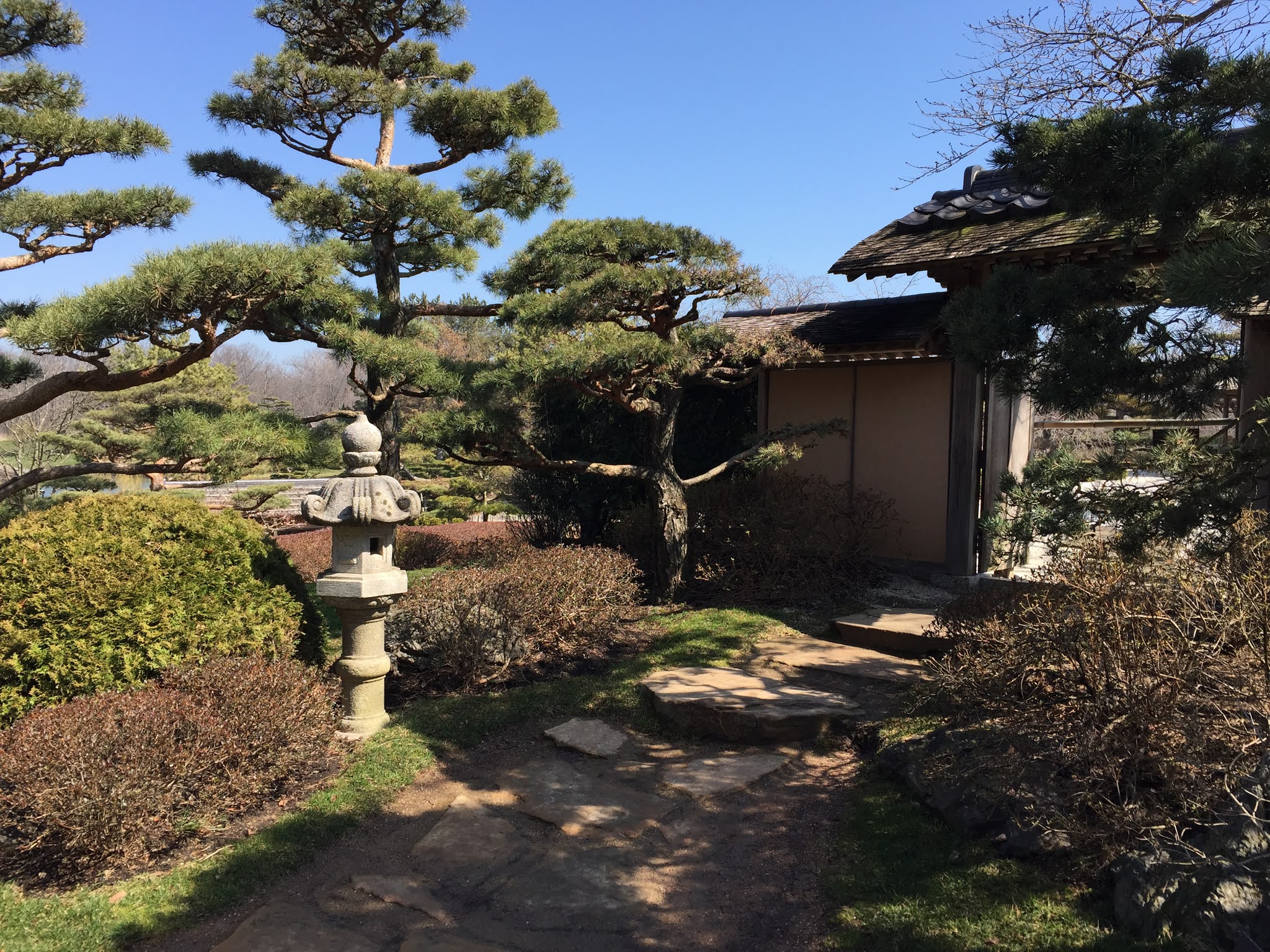
Chicago Botanic Garden in Glencoe, Illinois (Chicago suburb) is a great place for kids to learn about horticulture.  Look on their website for special events.  I've been to the garden multiple times, but I most enjoyed a Girl Scout event that included dividing houseplants and planting the new plant to help earn a badge.  At the end of the event, we had a private tour of the garden including the Elizabeth Hubert Malott Japanese Garden and greenhouses.  The Chicago Botanic Garden is huge with over 27 gardens within 385 acres.  It's no wonder over 1 million people visit annually.  With approximately 50,000 members, it's the largest membership of any U.S. public garden.  Considering the size and diversity, I'll focus on how kids can learn about horticulture and the Japanese culture in the same place.

To get the lay of the land, the Japanese garden has 17 acres and includes three islands:  1) Seifuto (Island of Clear, Pure Breezes), 2) Keiunto (Island of the Auspicious Cloud), and 3) Horaijima (Island of Everlasting Happiness).  The first two island has public accessibility.  You most likely won't have a guide, so I suggest downloading the garden app, so you and your kids can learn the meanings of the sites.  I've taken a short snapshot of the descriptions provided on the website for you:
Stop 1:  The Ken - viewing point where all three islands can be seen at one spot
Stop 2:  The "Waterfall" - plants create nature scene (boxwoods = stones, cotoneaster flowing downhill = flowing water)
Stop 3:  Kasugastone Lantern - name from Kasuga Shrine where there are nearly 1,000 lanterns
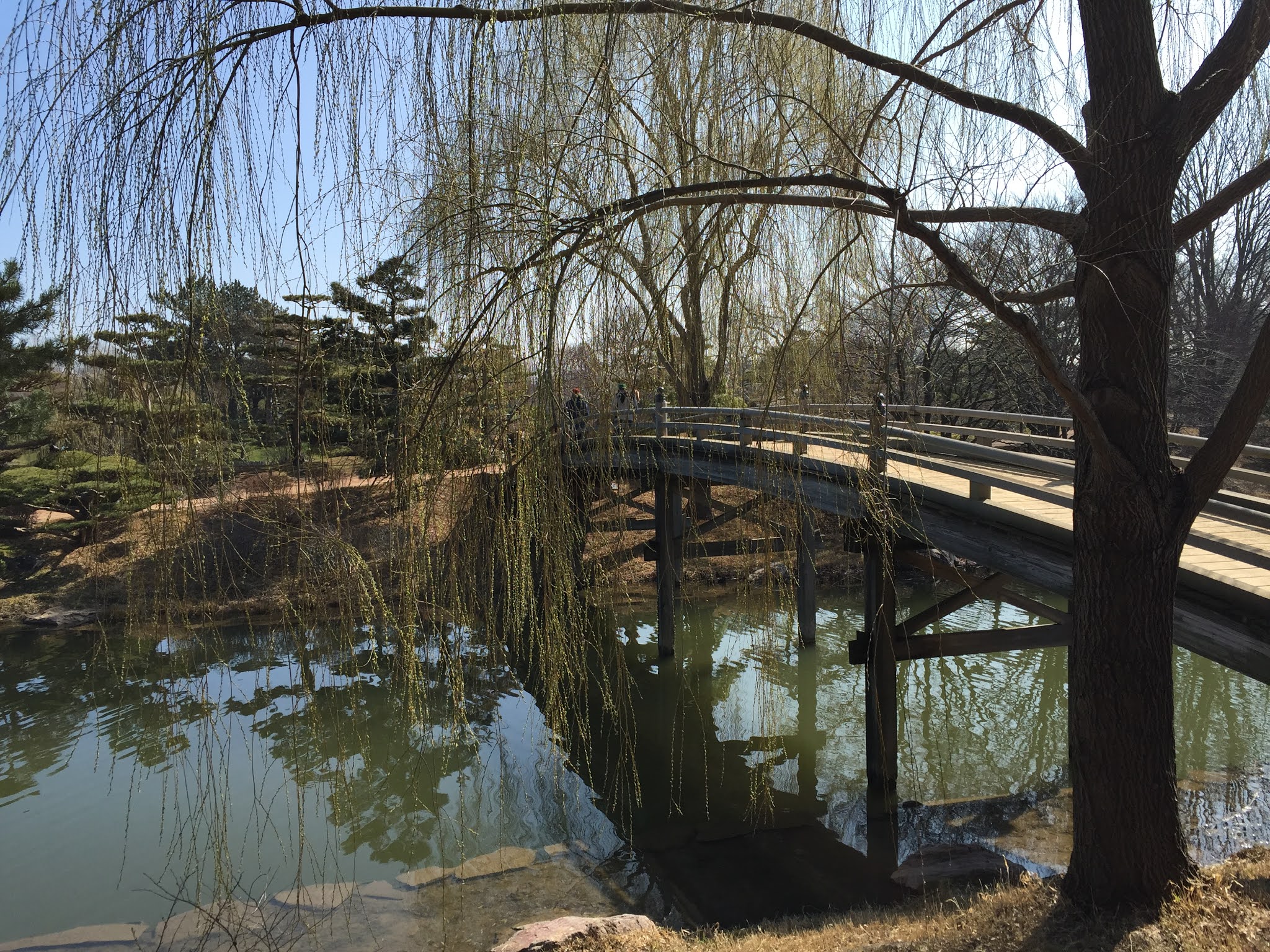
Stop 4: Japanese Garden Bridge - link between this world + paradise with an arch representing the difficulty of the path
Stop 5:  Keiunto - most formal of the gardens


Stop 6:  Dry Landscape Garden - smooth gravel represents calm matter, raked rippled patterns represent waves breaking on a shore; peek into the garden from the house


Stop 7:  Arbor - house adapted from a building at Kodai-jiya Koyota temple, built in Japan and assembled in Chicago

Stop 8:  Crouching Basin - tradition to wash hands and rinse mouth before entering teahouse

Stop 9:  Zig Zag Bridge - legend tells story that people can avoid evil spirits by crossing a zigzag bridge because evil spirits believed to move only in a straight line

Stop 10:  Seifuto - stone lantern and grouping of boulders; rocks are thought to be the bones of the earth

Stop 11:  Boat Landing Stones - 2 large granite slabs for an ornamental boat landing

Stop 12:  Dry Garden and Arbor House - smaller dry garden than on Keiunto; notice the water basin and lantern

Stop 13:  Willow - uneven pathway of stones to make you step more deliberate; notice the pruned willow

Stop 14:  Pine Tres - symbols of long life in Japanese culture

Stop 15:  Shoin House:  Recreated garden retreat of an Edo-period feudal lord built in Japan

Stop 16:  Water basin at the Shoin House

Stop 17:  Snow-Viewing Lantern - yukimi lantern built with sturdy legs and broad umbrella, enabling it to bear the snow

Stop 18:  Puryear Point - bridge views and sculptures

The Forest Preserve District of Cook County owns the garden and the Chicago Horticultural Society manages the garden.  There's an agreement for free admission (beyond the $25-$30 parking fee per day) until 2022, so visit now.