Showing posts with label Chicago. Show all posts

5.06.2020

Thinking Global in the USA #5: Italy & Leaning Tower of Niles (Chicago Suburbs)

During my month long backpacking journey across Europe, I really enjoyed Italy. Friendly people, sunshine, beautiful architecture, and gelato make you smile! I visited famous monuments including the Leaning Tower of Pisa. The tower stands behind the Pisa Cathedral and tilts, making for fun photographs. It's only a town of less than 100,000 residents. Who knew that unstable foundation and sinking architecture could make a small town so famous. With the travel ban to Europe during the pandemic, our family decided to find local monuments in Chicago suburbs which make us feel like we visited a different country. That's how we mapped a trip to Niles, Illinois, sister city to Pisa and home of the Leaning Tower of Nile. At 94 feet tall approximately the height 177 feet Leaning Tower of Pisa. Built in 1934 and later added a reflecting pool. The main event also consists of fun photos. Selfies with the teens was a hit. Despite the exciting architecture, the site had only a few visitors at our weekday excursion, making it easy to social distance. 

The surrounding area is grassy, making it perfect for a picnic. We brought our picnic blanket and Italian beef sandwiches ordered nearby. The kids reminded me that Italian beef began in Chicago, not Italy. That later led to a special trip to Tony's Canoli's, closer to home in the Chicago suburb of Mundelien. Like gelato, you should splurge and try all the flavors such as pistachio, hazelnut, lemon, turtle, and chocolate orange. We had the extra treat to meet Tony himself. If you live in the city, you might try D'Amato's Bakery as listed in Spoon University's "Where to Find the 24 Most Mouthwatering Cannolis in America." Like Tony's Canoli's, D'Amato's Bakery is also a family owned business. Next on the wish list is a visit to Little Italy in Chicago. According to "The Best Little Italys in North America" (Escape Here, Estrella Mora-Luna), Chicago rates as the top three Little Italy: 1. San Diego, CA 2. Philadelphia, PA 3. Chicago, IL 4. Manhattan, NY 5. Boston, MA

4.18.2018

Global Thinking in the USA #3: Chicago Botanic Garden's Japanese Garden


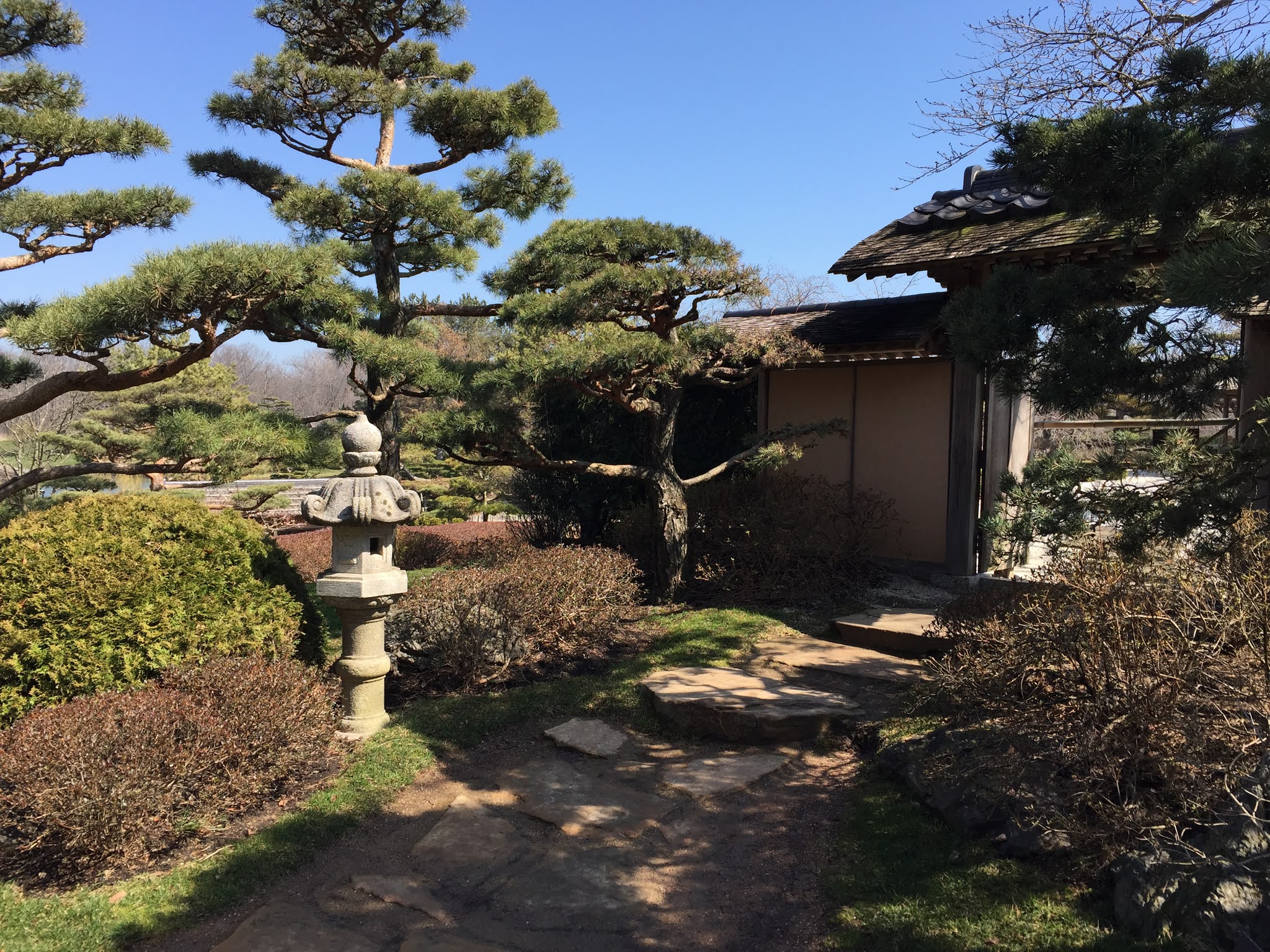
Chicago Botanic Garden, Photo by Krenda
Chicago Botanic Garden in Glencoe, Illinois (Chicago suburb) is a great place for kids to learn about horticulture.  Look on their website for special events.  I've been to the garden multiple times, but I most enjoyed a Girl Scout event that included dividing houseplants and planting the new plant to help earn a badge.  At the end of the event, we had a private tour of the garden including the Elizabeth Hubert Malott Japanese Garden and greenhouses.  The Chicago Botanic Garden is huge with over 27 gardens within 385 acres.  It's no wonder over 1 million people visit annually.  With approximately 50,000 members, it's the largest membership of any U.S. public garden.  Considering the size and diversity, I'll focus on how kids can learn about horticulture and the Japanese culture in the same place.

To get the lay of the land, the Japanese garden has 17 acres and includes three islands:  1) Seifuto (Island of Clear, Pure Breezes), 2) Keiunto (Island of the Auspicious Cloud), and 3) Horaijima (Island of Everlasting Happiness).  The first two island has public accessibility.  You most likely won't have a guide, so I suggest downloading the garden app, so you and your kids can learn the meanings of the sites.  I've taken a short snapshot of the descriptions provided on the website for you:
Stop 1:  The Ken - viewing point where all three islands can be seen at one spot
Stop 2:  The "Waterfall" - plants create nature scene (boxwoods = stones, cotoneaster flowing downhill = flowing water)
Stop 3:  Kasugastone Lantern - name from Kasuga Shrine where there are nearly 1,000 lanterns
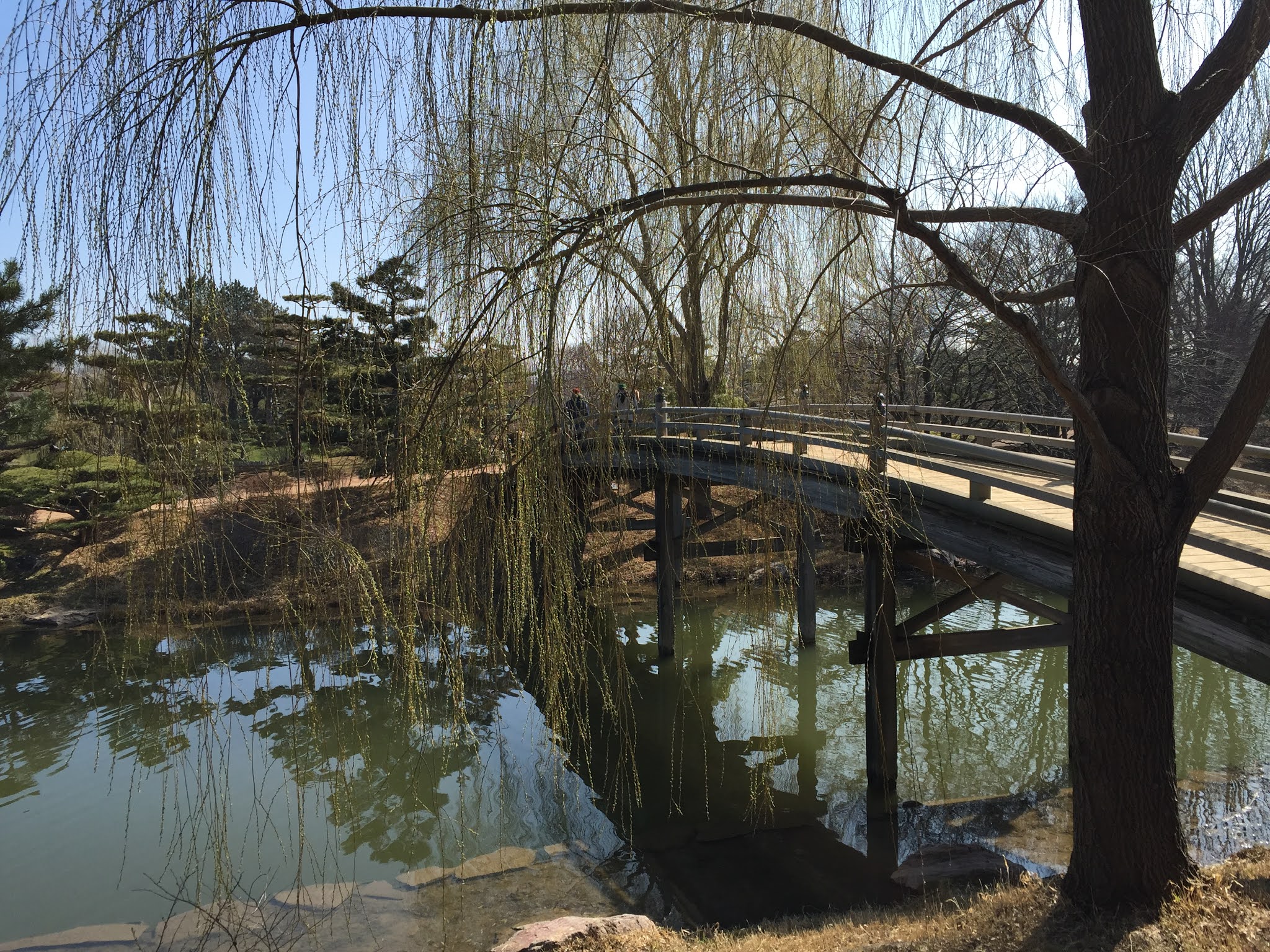
Stop 4: Japanese Garden Bridge - link between this world + paradise with an arch representing the difficulty of the path
Stop 5:  Keiunto - most formal of the gardens


Stop 6:  Dry Landscape Garden - smooth gravel represents calm matter, raked rippled patterns represent waves breaking on a shore; peek into the garden from the house


Stop 7:  Arbor - house adapted from a building at Kodai-jiya Koyota temple, built in Japan and assembled in Chicago

Stop 8:  Crouching Basin - tradition to wash hands and rinse mouth before entering teahouse

Stop 9:  Zig Zag Bridge - legend tells story that people can avoid evil spirits by crossing a zigzag bridge because evil spirits believed to move only in a straight line

Stop 10:  Seifuto - stone lantern and grouping of boulders; rocks are thought to be the bones of the earth

Stop 11:  Boat Landing Stones - 2 large granite slabs for an ornamental boat landing

Stop 12:  Dry Garden and Arbor House - smaller dry garden than on Keiunto; notice the water basin and lantern

Stop 13:  Willow - uneven pathway of stones to make you step more deliberate; notice the pruned willow

Stop 14:  Pine Tres - symbols of long life in Japanese culture

Stop 15:  Shoin House:  Recreated garden retreat of an Edo-period feudal lord built in Japan

Stop 16:  Water basin at the Shoin House

Stop 17:  Snow-Viewing Lantern - yukimi lantern built with sturdy legs and broad umbrella, enabling it to bear the snow

Stop 18:  Puryear Point - bridge views and sculptures

The Forest Preserve District of Cook County owns the garden and the Chicago Horticultural Society manages the garden.  There's an agreement for free admission (beyond the $25-$30 parking fee per day) until 2022, so visit now.


3.17.2018

Mom Blooper #2: St. Patrick's Day in Chicago

St. Patrick's Day began as a public holiday in Ireland in 1903.  It celebrates Patrick, a missionary and bishop who converted Irish citizens to Christians.  The shamrock, a three-leaved plant, was used to explain the Holy Trinity (unity of Father, Son, and Holy Spirit).  March 17th marked his date of death.  Christians of the Catholic Church, Anglican Communion, and Lutheran Church especially recognized the date.  Many countries now celebrate St. Patrick's Day and people enjoy wearing green and shamrocks.
Chicago is often cited as ranking within the Top 10 of St. Patrick's celebrations in the world with four locations prior: 1) Dublin, Ireland, 2) British Virgin Islands, 3) New York, and 4) Boston.  Chicago's famous tradition is using eco-friendly vegetable dye to make the river turn a vibrant emerald green.  The color lasts five hours, so citizens and tourists line the river and later walk to the parade.  The parade is also recognized because it is one of the largest St. Patrick's Day parades.  

With downtown Chicago only an hour away, it sounds like a terrific family event.  I knew parking could prove difficult considering the expected 400,000 spectators.  It made sense to take the train downtown.  There begins the Mom Blooper.  If I had conducted a bit more research, I would have also seen the event descriptions as "raucous pub crawls to lively parades, jovial crowds."
I might have noticed the Wikipedia description of the U.S. celebration as including "copious consumption of alcohol".  
The minute we boarded the train, I knew we had an adventure on our hands.  Most of the other passengers were drunk teenagers, drinking hidden alcohol in water bottles.  Each stop picked up more loud drunk teenagers.  We needed a restroom on the walk to the river.  The women's restroom with an overflowed toilet, I had to referee a bunch of teenage boys and explain that both the girls and the boys could take their turns using the one boys bathroom stall.  The kids still found the river amazing.  The kids still liked the costumes and balloons.  We followed the crowd to the parade route.  We walked slowly and carefully through the thick, dense crowd; we thought we'd lose a kid.  If the train was full of drunk teens in the morning, I could only imagine the ride home.  I was right.  The conductor raised his voice and tried to get some control.  On the upside the journey provided a teaching moment, "see what happens when teenagers drink too much." 


11.04.2017

Language & Theater: Blue Men Communicate Without Words

You can find different percentages on how much communication is verbal vs. non verbal.  Consider the 55/38/7 rule of personal communication:  55% of communication as body language, 38% tone of voice, and 7% actual words spoken.  Consider the 60/40 rule:  60% communication as facial and 40% vocal.  Either way, we know that we tell stories through movement, not just words.  We watch facial expressions, body posture, gestures, eye movement, and touch.  That explains why artists can create an entire show without spoken words and have a great hit.

We took our kids to the Blue Man show at the Briar Street Theater in Chicago.  They didn't know the show's history, so they didn't know it was an award winning show which began in New York City in 1987.  They feared mom was just taking them to another show.  They loved the show!  Who couldn't love a show that integrates Cap'n Crunch, marshmallows, and Jell-O with humor and expression.

The Blue Men show has three blue men as the stars.  They have talent as percussionists and mimes.  They use non-traditional instruments like plastic pipes to create music.  They comment on contemporary life, science, and technology without using a word.

Clearly the audience had repeat customers.  They knew how to interact with the show before it even began.  Enthusiastic theater attendees wore ponchos in the front rows, anticipating splattered liquids like paint.  Audience members can get pulled out of their seats to participate in a painting skit or dinner serving Twinkies.  After the show, the Blue Men appear in the front entrance for photos.

The blue men represent outsiders to the rest of the world with surprised reactions to modern world items.  Yet the Blue Men have become part of the world beyond New York, performing in 15 countries.  They performed twice at the Latin Grammy awards.  If you want to see a show, look for performances in Berlin, Boston, Chicago, Las Vegas, New York City, and Orlando.


6.17.2017

Architecture Lesson #2: Chicago Water Taxi and 3 Boat Tours

A trip to a big city gives you an opportunity to showcase architecture.  You can talk about building types and materials and structural concepts.  Before your outing, draw together different structures such as a suspension bridge, arch, column, post and beam, and dome.  Then on your trip, see who finds the structure first.  You can really make the adventure fun by taking a boat ride and viewing the buildings from the river.

Thanks to our cousins for taking us on the Chicago water taxi.  Tickets cost only $10 for an all day pass and you can buy them onsite at 400 North Michigan and Trump Plaza.  If you want to outsource the architecture lessons to an expert, Chicago has several architecture tours:

1.  Chicago's First Lady Cruises - 90 min, $40 daytime, $43 night ride - Riverside Garden site, learn design of 50 buildings; now ranked by Trip Advisor on the list "10 Great US Tours"
http://www.cruisechicago.com/

2.  Wendella Chicago River Architecture - 75 min tour, $30 adult, $15 children under age 11 - dock near Trump Tower, learn about the architects;
https://www.wendellaboats.com/


3.  Shoreline Architecture Tours - 75 min. tour, adult $35 day, child $21 day, $29 adult night tour, $13 child night - see the Wrigley Building, Trump Tower, Marina City and more.  Depart at Navy Pier's Polk Bros Park;
http://shorelinesightseeing.com/


If you prefer to combine sports and architecture, use your muscle and kayak the river with Kayak Chicago: $69/person 
http://www.kayakchicago.com/tours/architectural-tour/


After the trip, talk about the types of building people live in today.  Perhaps you live in a house, but you saw a lot of apartments in the big city.  Ask your kids about other structures from the past (igloo, teepee, log cabin, pyramid).
"The Bean", Photo by Krenda

 We ended the trip walking to Millennium Park and admiring the Cloud Gate sculpture.  The reflective steel sculpture commonly called "The Bean" was the first public artwork in the US by the famous artist Anish Kapoor.


11.05.2016

Social Sciences & Economics: 5 Free Places to Learn About Money

 Economics, a branch of social science, studies human behavior and scare means.  This article dedicated to my friend working in the Congressional Budget Office in DC.

Kids can learn about goods and resources every time we go shopping and discuss income and expenses.  There's so much more to discuss.  Economist study business climate, the labor market, drivers in fluctuations in oil prices, inflation, and foreign exchange.  President Wilson signed the Federal Reserve Act in 1913.  The US needed a system to stabilize markets, promote financial stability, and setting monetary policy.  Consumers needed confidence and protection and federal banks could ensure banks remained compliant with consumer protection laws.  Bank mergers and acquisitions could be reviewed at the federal level.  The economist and government helped identify solutions to the stock market crash of 1929 and 1987 and financial crisis of 2007-2008.

History, economics, politics, and business can come together in stories.  In 1933, President Franklin Roosevelt needed to rebuild confidence in banking and Congress passed the Emergency Banking Act.  It allowed twelve Federal Reserve Banks to issue additional currency.  Later, the 1933 Banking Act formed the Federal Deposit Insurance Corporation (FDIC).

If you want to bring the concepts alive, consider visiting a money museum.  Please note you'll need to pass security and show government-issue photo id for such government run money museums.  We took the kids to the Federal Reserve Bank of Kansas City The Money Museum (1 Memorial Drive, open 9:30-4PM).  When you enter, you'll see the Harry S. Truman Coin Collection containing over 500 historic coins.  The exhibit includes a $40 million wall with $40 million stacked up.  See a gold bar worth nearly $500K (depends on the timing).  Kids also learn about counterfeit at an exhibit explaining security features designed in currency.  At the end, the employees gave each kid a small bag of shredded cash.  That may have created the most excitement.

Here's five more free entrance places to learn about the economy and banking:

1. Federal Reserve Bank of New York, New York, NY (44 Maiden Lane), M-F 1 & 2PM one hour tours, limited space for public tours and registration opens 30 days prior to requested date, no strollers, no late entrance, security screening first 

2. Atlanta Money Museum, Atlanta, GA (1000 Peachtree Street NE), M-F 9AM-4PM self-guided tours, M-F guided tours at 9:30 AM, 11AM, and 1PM, vie of the banks' automated vault and cash processing area, see robotic transportation, see where dollars are counted, sorted, and shredded daily

3.  Chicago Fed's Money Museum, Chicago, IL (Federal Reserve Bank on 230 South LaSalle St), M-F 8:30-5PM, 45 minute self guided tour, 30 minute guided tour M-F 1PM

4.  Detroit Branch Visitors Center, Detroit, MI (1600 East Warren Avenue), M-Thur. 9AM-4PM, one hour tours

5.  The Denver Money Museum, Denver, CO, (1020 16th St), free, kids can use crayons to design currency, learn the history of the Federal Reserve


9.03.2016

Gym Class #10: 4 Trampoline Development Centers

Photo by Krenda
Want to get their hearts pumping?  Go to a trampoline facility and let them soar.

According to CNN, trampoline is one of the 10 strangest Olympic Sports, along with 1) solo synchronized swimming, 2) club swimming, 3) tug-o-war, 4) live pigeon shooting, 5) swimming obstacle course, 6) roller skating, 7) la canne (canes, similar to fencing), 8) rope climbing, and 9) race walking.  The vast majority have not been included in recent Olympic games.  However, trampoline is fairly recent.

London England held the first Trampoline World Championships (1964).  Sydney, Australia hosted the first Olympics to feature trampoline (2000).  Did you know the inventor learned from a kangaroo and actually jumped with a kangaroo on his trampoline?  Your little joey can have so much fun too. 


Trampoline offers much more challenge than who can jump highest.  Try a half turn, tuck jump, straddle jump, and seat drop.  For the gymnasts, they may jump as high as 33 feet and show off other tricks: 
1) Barani - front somersault with a half-twist
2) Cody - backward somersault from the front
3) Quadriffis- any quadruple somersault from the front.

USA Gymnastics chooses a limited number of clubs as Trampoline Development Centers, encouraging competitive trampoline sport.  In 2016, USA Gymnastics chose the following four clubs:
1.  De Veau's School of Gymnastics in Indianapolis, IN
2.  Mini Hops Gymnastics in Plymouth, MN
3.  Legacy Training Center in San Luis Obispo, CA
4.  International Gymnastics Centre Inc. in West Sacramento, CA


We've used trampoline facilities in Fort Wayne, IN and Buffalo Grove, IL (near Chicago).  Both offered more than jumping.  Both offered a foam pit and dodge ball games.  No need to bring a team.  Just join the fun.  Safety first.  The facilities provide safety videos and signs.  Always good to reinforce the message yourself with your kids.

Tips:
1) Bring comfortable clothes, but not too much stuff - you'll likely want to rent a small locker.  Facilities often require socks with grips and sell them at a reasonable price.  2) Set a realistic time.  You can purchase 2 hours, but you may not need it.  One hour or even 30 minutes may suffice.  Especially if you use competition rules - routine terminates if you touch the side panel or stop (-:

When you go on vacation, sometimes the weather just doesn't cooperate.  Pack your grip socks.  If you are vacationing in the Smoky Mountains, check out Top Jump Trampoline Park in Pigeon Forge (between light #8 and 10).  If you need to rent a luxury cabin, check out our rental nearby named Indigo Moon Lodge www.indigomoonlodge.blogspot.com.

8.06.2016

Gym Class #8: Yacht Competition & 6 Schooner Rides

America's Cup, Photo by Krenda
America's Cup established in 1851, making it the oldest and most prestigious yacht racing.  America's Cup name came from the 1851 winning schooner America.  Six members of the New York Yacht Club built America and beat fifteen yachts in the UK during the World's Fair.  America finished miles ahead of the others and  it began a winning streak for Americans.  A famous line cam from Queen Victoria asking who came second and the simple response "Ma'a, there is no second." Americans won the trophy for 132 years.  Australia broke the winning streak in 1983.  

2016 marked the year of the first America's Cup race held on fresh water.  Fortunately for our family that location was off the shores of Chicago on the Great Lakes.  The America's Cup qualifying races included six teams from around the world:  1) Emirates Team New Zealand, 2) Softbank Team Japan, 3) Team France, 4) Oracle Team USA, 5) Land Rover UK, 6) Artemis Racing Sweden. 
 
Yacht races know the media well.  The first use of the wireless telegraph was to report cup races from the water.  ESPN began live coverage in 1987.  Rather than watch the event on tv, I took my family to watch the event from the water.  We took a ride on the schooner Tall Ship Red Witch.  The boat ride itself was joy, passing the Chicago shoreline under the sun.  Our captain did use media, turning up the radio so we could hear about the race while watching it.
The competing yachts seemed to fly above the water at approximately 35 knots or 40 miles per hour.  Foiling happens when the boats reach a certain speed and skim over the water.  Both powerful and graceful, the movement amazed me.  

Photo by Krenda
No doubt that yachting has been a sport for the wealthy.  It's involved business owners like French manufacturing tycoon Baron Marcel Bich (Bic pen).  Volvo and sixty other Swedish companies supplied money, technology, and research in 1977.  Now professionals sailors compete in the high stakes competition.
You can sail with your kids for under $50 per person.  Consider a short sail.  We took a special event sailing on Tall Ship Red Witch in Chicago, but Red Witch normally has low sailing price of $25 out of Kenosha Harbor in Kenosha, WI.  Here's other options:

1.  Schooner Pride (Charleston, SC), 2 hour dolphin sail $42 adult, $30 child
2.  Traverse Tallship Co. Manitou in Grand Traverse Bay (Traverse City, MI), 114-foot 19th century cargo schooner replica, Moomers ice cream sail $43 adult and $23 child; floating B&B overnight $217 to 245 couples
3.  Schooner Surprise (Camden, Maine), 2 hour sunset cruise $45 adult and $35 child 
4.  Inland Seas Education Association Great Lake Discovery Sails in Suttons Bay (Suttons Bay, MI), 77-foot schooner, various themed sails, Astronomy Under Sail or Breakfast on the Schooner, adult $45 
5.  Dennis Sullivan (Milwaukee, WI), 137-foot schooner, 2 hour sail $45 adult, $40 child
6.  Schooner America 2.0 in New York Harbor (NY, NY), 2 hour Day Sail to Statue of Liberty $60 adult, child $32 


2.01.2014

Thinking Global in the USA #2: 7 US Cities to Celebrate Chinese New Year


Chinese New Year has been celebrated for more than four thousand years.  It's a two week festival marking the end of winter and beginning of spring.  Over a billion people around the world celebrate Chinese New Year.  For a fun geography lesson, mix holidays and locations;  challenge your kids to find 7 countries/territories in Asia that celebrate the Chinese New Year:  1) China, 2) Hong Kong, 3) Philippines, 4) Malaysia, 5) Indonesia, 6) Thailand, 7) Singapore.
Festivities at Chinese New Year; Evansville, IN

Before the event, practice a few of the traditions: 
1) Clean the house, sweeping out the ill fortune, making space for good luck
2) Decorate the house, place tangerines and oranges on display as a sign of luck and wealth
3) Give kids money in a red envelope, symbolizing happiness, good luck, and wealth

Ribbons and Beautiful Costumes; Evansville, IN
You don't need to travel to China for your family to enjoy the Chinese New Year celebration.  Chinese make up the 3rd largest immigration group in the US and they welcome you to celebrate Chinese New Year, also known as the Spring Festival or Lunar New Year. 
It occurs on the last day of the month of the Chinese calendar (Feb. this year).

Dragon in Evansville, IN; Photo by Krenda
A friend of mine at work asked if my family would like to attend Chinese New Year at St. Paul's Lutheran Church in Evansville, IN.  My friend and his wife planned to perform a duet.  Of course I replied "Yes!"  We enjoyed the traditional dragon dance (photo above), violin and yo-yo performances, dances, costume show, and delicious dinner.  Dragons are a powerful symbol in China and believed to bring good luck.

Chinatown in Chicago
Dragon at parade
 When we moved to Chicago, of course I wanted to visit Chinatown.  I coordinated the timing to occur on the New Year's parade.  If you go, go early.  Parking proved more difficult than we anticipated.  After a brisk walk in the cool weather, we arrived and listened to government officials introduce the events.  The streets were crowded, making it difficult for the kids to see everything.  Glad the dragon bobs and weaves above and floats had scale and height.  The restaurants also had crowds and waiting lines.  Just another excuse for us to return on another day.


Look for parades and events in your town.  Here's 7 US cities offering festival events:
Float in Chicago parade
1.  Kansas City - $20 tickets include speech competition, cultural fair, piano and violin recital
2.  Chicago, IL - 2 parade - Argyle and Chinatown, concert at Symphony Center
3.  Philadelphia, PA - midnight lion dance at 11PM and parade at 11AM
Chinatown in Chicago
4.  New York, NY - parade in Chinatown and martial arts demonstrations
5.  Butte, Montana - parade and 10,000 fireworks
6.  San Francisco, CA - Lunar New Year parade and Miss Chinatown USA crowning
7.  Seattle, Washington - parade, costume content, Hawaiian dances, Japanese taiko drumming


7.28.2013

Enjoy the journey & other lessons learned


Here's a life story about life being a journey and enjoying every step of the way, seeing the possibility, and learning every day.
When I tell people, Iowa, that's where I was born
They tease me about endless flat land and corn
That's where I grew values and how to work hard
Pride in farmers and Americans, things you can't learn from a card

Relatives warned don't go north to Appleton where it's cold
Women wear flannels and hunt deer, young and old
I learned to follow my own dreams with the precision of a bow
Have courage and strength and cheer on my teams, go, go, go!

Elders shook their head about moving to the capitol, Mad Town
Be careful they exclaimed, you could become a politician or clown
That's where I led communities and debate ideas with zeal
The government, the university, all part of the appeal
Friends rolled their eyes, friends don't let friends go to Fort Wyane
Not enough parties or people, you'll have to escape by plane
I only needed to find one person, the love of my life
I loved responsibility, a career, and throwing parties as a wife

Those settled questioned, why Bloomington, a town so small?
Why risk your paycheck and take a chance that you'll fall?
Big ideas from Asia, Africa, Europe, and many states
We triumphed in case studies, internships, a big success at any rate

Classmates pointed out Cincinnati isn't close to a beach
So serious, so focused on industry, life won't be a peach
I learned to turn around businesses in need
With little ones we grew fruit trees, gardens, and good deeds

Collegues warned don't leave for Evansville, a smaller river port
Watch out for cowboys and the religious sort
That's where I feel most comfortable to kick up my boots
And sing praises so loud, a place where kids can grow roots

Neighbors ask why buy property in the mountains, so close to the sky
You could get attacked by a bear, you can't even fly
That's where I appreciate nature so majestic and free
I embrace the danger, the adventure, and all that I can be

Strangers warned don't move to a bankrupt, high tax state
The traffic, the crime, you know it leads to hate
Chicago has energy, diversity, and new food to taste
So many museums and parks, there's not a moment to waste

Shoot for the stars and don't let anyone hold you back.  Experience new places and cultures, you'll never stop learning.  And whenever you hear negative stereotypes, search for the positive instead.