Showing posts with label Illinois. Show all posts

1.02.2021

Transportation Lesson #8: Illinois Railway Museum & 6 Other Midwest Rail Museums

Here comes the train

You probably recall the American folk song "I've been working on the railroad" from your childhood.  Kids still hear it today on Loony Tunes or Barney.

The Golden Age of Railroading was considered to take place from period of 1880 to 1916.  That's when the United States had an unprecedented rate of expansion from 93,000 to 254,000 miles of track, according to Iowa University Libraries.  You may not be able to go back in time, but you can get close to trains.  Do you know that you can still work on trains, even without experience?  Most train museums operate with mostly volunteers.  You could greet visitors, demonstrate technology, help organize archive & collections, sell items in the gift shop, work in the office, sell tickets, and/or refurbish locomotives. 

All aboard
"Can't you hear the captain shouting , 'Dinah, blow your horn."  If you don't have time to volunteer, take your kids to the train museum and meet the engineers.  One of our family outings took us to the Illinois Railway Museum.

Location:  Union, Illinois (approx. 1 hour Northwest of Chicago, IL)

Cost:  $15 or less per person, depending on season and age; Free parking

Includes unlimited train rides (except for special-fare days) and access to all the exhibits

If you go, wear your walking shoes for the self-guided tour.  This museum holds the largest collection of historic railway equipment in America from restored Pullman sleeping cars in Barn 3 to trolleys in Barn 7.  We visited every barn and took both the train rides (street car that loops around the property for 15 minutes and the transfer to main line diesel train - available in summer).  Don't miss the Nebraska Zephyr, the only remaining articulated streamliner of it's type and star of the move "A League of Their Own."  I also recommend this movie!

Photo by Krenda

Tip:  We ate at the diner, but you could save by bringing your own food and using a picnic table.

"Fee, fie, fiddy-i-o, Strummin' on the old banjo"  Perhaps you are looking for a smaller or different experience.  Here's other Midwest Railway musuems to consider:

1.     Hooiser Valley Railroad Museum (North Judson, IN) - 1.5 hours Southeast of Chicago

- free admission, but train rides cost $12

- Guest Engineer Program, 18 and over $240 learn how to pull back on the throttle, ring the bell, blow the horn in the cab of a diesel, 1 hour of operation

2. National New York Central Railroad Museum (Elkhart, IN) - 2 hours Southeast of Chicago

- $6 admission, family membership $40, largest surviving example of a NYC Steam locomotive

- The New York Central was once the second-largest railroad in the U.S.

3.  Monticello Railway (Monticello, IL) - 2 hours South of Chicago

- Wabash depot, Nelson Crossing depot, locomotives, cabooses, passenger cars, freight cars

- Housing for volunteers to stay overnight at The Villas at Hodge Park

The train returns
- $10 train rides Sat. & Sun. in summer; $20 surcharge for cab ride; max 2 cab riders per trip

4. Mid-Continent Railway Museum (North Freedom, WI) - 3 hours Northwest of Chicago 

- largest collection of wooden passenger cars in the U.S., 13 steam, 7 diesel locomotive

- 7-mile heritage railroad passing through the former mining community of La Reu, special 1 hour rides from $22 (Coach in Sept., Harvest Limited, Santa Express in Nov./Dec.)

5.  Galesburg Railroad Museum (Galesburg, IL) - 3 hours Southwest of Chicago

-$6 admission Fri./Sat/Sun. or by appointment, Galesburg history where once >3.3K rail employees

-Visit during Railroad Days, a festival with 300 tables of model trains, >50 vendor tables of toys, arts & crafts market, Firefighter's water fights, car cruise in, festival has extra fees

6.  National Railroad Museum (Ashwaubenon, WI) - 3.5 hours North of Chicago, near Green Bay, WI

- popular museum with over 100,000 visitor per year and 300 volunteers

- $11 entrance, $2 for a 25-minute train ride with museum admission 

- Don't miss the Union Pacific #4017 Big Boy, only 25 constructed & weighs 1.1 million pounds

 "Can't you hear the whistle blowing.  Rise up so early in the morn."  It's your cue to get up early and listen to the sounds of the whistles and clickety clack of the rails.

11.28.2020

Gym Class #13: Ski Jumping from Norway to Illinois

Ski Jump, Photo by Krenda
 Ski jumping is one of three nordic skiing disciplines which includes cross-country skiing, ski-jumping, and nordic combined (cross-country plus jumping).  In 1808, ski jumping began in Norway and the first public competition was also held in Norway 54 years later (1862).  Not much longer, the sport came to the United States.  With so much publicity about skiing in Colorado, you might have thought it began in the West.  It actually began in the Midwest.  The first US ski-jump located in Red Wing, Minnesota.  Three Norwegians came over and started the ski club.

The places with ski jumping history still play an important role in ski jumping.  Norway holds the most medals (398 total).  For comparison, the US holds 17.  Mikkel Hemmerstvedt, a Norwegian immigrant, earned the first US distance record in Red Wing (1887) and then later Mikkel set a new world record (102 feet).  You can visit The American Ski Jumping Hall of Fame and Museum at the St. James Hotel in Red Wing, Minnesota.  This HOF is separate from the National Ski Hall of Fame, only focused on ski jumping.

The sport spread from the Midwest to the West and East.  Wisconsin now lists the most ski jump locations (Camero, Eau Claire, Madison, Wisconsin Rapids, Iola, and Westby).  While Illinois only has one ski jump location listed (Fox River Grove, Illinois), we fortunately live close enough to drive for an event without a hotel stay.  The Norge Ski Club in Fox River Grove began early (1905) and remains a volunteer club to prepare athletes for Olympic-level competition.  It's considered one of the top learning centers for Olympic ski jumping in the USA with 5 jumps.  The jumps have availability year round and range from beginner to advanced jumps.  In 2018, three Norge Ski Club Olympic athletes (Mike Glader of Casey, Kevin Bickner formerly of Wauconda, Casey Larson of Barrington) traveled to Red Wing, Minnesota to accept the honor of American Ski Jumping Hall of Fame induction.

The sport has both Junior Tournaments and Masters Competitions (age 30 and older).  The International Ski Federation (FIS) organizes events.  Ski jumping existed in the Winter Olympics since 1924.  The FIS Nordic Ski Championship begin in 1925.  First held in France, the US held the competition in 1950 - the first championship outside Europe.  Switzerland hosted the first FIS Junior World Championship (1977) and the US hosted twice (Lake Placid, NY 1986, Park City 2017).  

If you live near Illinois, you should visit the Norge Ski Club Annual Tournament in the end of January.  For a small entrance fee, you can watch the skiers fly.  We especially were impressed with the kids flying off the 150 foot jump.  The crowd watches for the longest jump after descending from the ramp.  The announcer broadcasts the results and the crowd cheers.  There's some costumes and beer drinking, but a nice family event with many fearless adrenaline driven athlete.


8.07.2020

Art Lesson #13: Six Giant Troll Statues at Morton Arboretum

The Six Forgotten Giants in Copenhagen, Denmark, designed by artist Thomas Dambo, is celebrated art in Europe.  Travel is restricted to Europe, but you can find the artist's work in the United States.  The Morton Arboretum in Lisle, Illinois is home to Thomas Dambo's first large-scale exhibit in the United States.  Since Thomas is known for using recycled materials and promoting sustainability, it's fitting that an arboretum combines such art with nature.

I've visited the Morton Arboretum before the pandemic.  My friend had a membership and invited me to Passport Europe Festival one September afternoon.  The festival is so big that the event holds multiple stages simultaneously.  You have to choose between dancing and musical performances.  Often lots of audience interaction, joy, and laughter.  My friend certainly giggled when successfully volunteering me to learn Polish dancing in front of an audience.  I was so impressed with the park.  It's much larger than I expected.  I later learned it covers 1,700 acres and has 222,000 live plants combined with scientific research, making it internationally known.

During the pandemic, it's still a great place to visit.  The crowd is limited by timed-entry with non-refundable tickets.  With such wide, open spaces, social distancing feels so easy.  While more expensive than local or state parks ($15 per adult, $10 child ages 2-17), you also contribute to a great cause.  Joy Morton, son of the founder of Arbor Day and founder of Morton Salt Company, created the arboretum after studying botanical gardens in Europe.  The non-profit organization collects and studies plants from around the world.  From your ride through the forest, you can visit the East Loop and West Loop and see distinct outdoor exhibits of Asian, European, and North American Collections.

Tip #1:  Use the App to Help Find the Six Giant Trolls

Without the map, it could be a challenge to find all six trolls, some hidden in the woods after a trail.  Even with the map and signs with arrows, it still feels like a hunt.

Tip #2:  Drive the Troll Hunt

If you don't drive, finding the trolls would take a six to seven mile hike.  From a parking lot, the hike does not feel strenuous.  It takes a two feet to three-quarters of a mile hike from the nearest parking lot.  You'll still get your family moving.  One hike took you up a hill and you could look over both the arboretum and the highway, along with the super tall troll.  Rocky Bardur:  visible from road, easy walk from parking lot #1

Tip #3:  Plan for a Couple Hours

Once we started the hunt, my daughter insisted we find all six sculptures.  Kids enjoy finding the cute trolls and parents admire the details of reclaimed wood with different natural colors, twigs, and pincones combining for character.  Due to the pandemic, trolls are now fenced off.  You can still get great photos of Rocky Bardur, Sneaky Socks Alexa, Joe the Guardian, Furry Ema, Niels Bragger, and Little Arturs.  I've placed Destination Asia Festival my wish list for post-pandemic entertainment in August.  Culture, nature, and art come together at the Morton Arboretum.

8.08.2019

Art & Sculpture #4: International Sculpture Park and 4 More Sculpture Parks in IL

Smithsonian Magazine lists "Six of the World's Most Spectacular Sculpture Parks...from New York to Norway". (Jennifeer Nalewicki, May, 6, 2019) and I've only been to one of them, twice (Olympic Sculpture Park, Seattle, Washington).

Even with travel restrictions, if you live in Illinois, you can share the joy of sculpture art with your kids.  For our staycation, we planned visits to places that felt connected to other countries.  We chose the International Sculpture Park in Schaumburg, IL.  A partnership between The Chicago Anthenaeum Museum of Architecture and Design and the Village of Schumburg turned this 20 acres of meadow, forest, and prairies into a park for art lovers.  Then we connect to Greece.  Ioannis Karalias, a Greek architect, planned the garden.

Here's good news for moms - no admission fee, no parking fee, open from sunset to sunrise, and the open space makes it easy to socially distance.

You'll enter the grounds of the Robert O. Atcher Municipal Center with free parking at the Prairie Center for the Arts.  You likely won't see the sculpture garden entry sign from the lot.  Take the prairie trail back towards the entrance.  You will see the entrance sign and "Together", an 18 foot sculpture by Jerry S. Kenar.

You can connect back to Greece with "Chairs" sculpture by Argyro Konstantinidou showcasing Greek themes and images from the history of Mexico, Egypt, and Greece.  "Athys" by Charles de Montaigu provides another connection to Europe since it represents contemporary art in Switzerland.  "Touch Heaven" connects you to Israel designed by Oded Italahmy and inspired by Judaic culture and iconography.  "Vinland" intrigued us so much that we looked up more about the sculpture by Jarle Rosseland of Oslo, Norway.  The sculpture commemorates the 1,000 year anniversary of the Viking explorer, Leif Eriksson and his discoveries of the Americas.  With that background, we could see the ship form.  Another favorite was "Thought Rise in Vacuum" by Hans-Christian Berg, combining the numbers "zero" and "ones" in a cloud-like pattern.

Fortunately we researched the park ahead.  My daughter knew we missed sculptures, even though the path seemed to end near a road.  Trace back to the parking lot and walk across the street for other sculptures.  We had a picnic lunch near the prairie and now we found lots of other picnics near the small lake.

My daughter particularly wanted to see "Awaking Muse" by Don Lawler.  It takes a lot of horizontal space at 40 feet across.  The female figure inspired by Greek mythology appears to awaken from her sleep.  Keep walking and you'll find the colorful "Ecceltora" meaning "Behold the Hour".  May you enjoy your hour at the sculpture park.

Here's four additional sculpture parks to consider visiting in Illinois:

1) West Street Sculpture Park, Galena, IL, 2 acres

2) Goldman-Kuenz Sculpture Park at Cedarhurst in Mount Vernon, IL (Southern IL)

3) Scovill Sculpture Park in Decatur, IL near zoo and museum

4) Koehnline Sculpture Park, part of Koehnline Museum of Art on Oakton Community College campus- Des Plaines, IL (north of O'Hare airport), 25 sculptures

For more sculpture parks in the Midwest, visit my article "Pyramid Hill and 4 More Sculpture Parks in the Midwest".

5.01.2019

Thinking Global in the USA #6: Korean Spa (Niles, Illinois)


Korean Spa Entrance, Photo by Krenda

Where can you find a Korean experience in Chicago and also leave feeling relaxed?  Take a day to rejuvenate at the King Spa & Sauna in Niles, Illinois (Chicago suburbs).  I've been to Korea twice and not had time to visit a sauna.  You can do it in the United States and the largest Asian sauna resides in Niles.  

In Korea, I did learn that you need a swim cap to swim in the hotel pool and you should not wear your bathing suit in the communal bath within the locker room of your gender.  The spa section of King Spa & Sauna has access through your gender locker room.  It also does not allow you to wear your swimsuit.  You'll find multiple pools with varying water temperature from hot to warm to very cold.  If you visit with your kids, you may choose to skip the spa section, use the locker room to change to the spa uniform, and venture into the 9 sauna sections and/or movie theater.  The experience does not come cheap.  I recommend you look on Groupon for discounted price or H-Mart grocery store nearby.  Massage has additional cost and Base Rock room has an additional $5 fee.

Base Rock room is unique, but has an extra fee.  You can find such patented room by Mr. Ono only in Chicago, Dallas, and Japan.  You lie down on a bed made of special hot stone slab.  The mineral stone Siraka comes from Japan and said to help heal.  You'll also notice amethyst crystal and coal in the room design.  The heat, lights, and quiet atmosphere made it a relaxing place.  The rock is quite hot, so keep on your thick cloth mat or it may not feel so relaxing.

The Pyramid Room, shaped like a pyramid, gives you another way to experience heat healing.  At approximately 90 degrees, I did not find the heat too hot, so it felt relaxing to me.  In contrast, I dared to enter and quickly exited the Fire Sudatorium.  I should have noticed all the other patron's eyes on me when I voluntarily entered and that no one else sat in the room.  At a 165-170 degrees, I think most pass on this room.

At the other extreme, try the Ice Room.  While you may not spend significant time chilling, it does provide a refreshing contrast after the heat.

Bul Ga Ma, the room I repeatedly visited, intrigued me with the wall patterns and pile of hot bricks that move from an oven and into the room.

The Charcoal Room aesthetics also has beauty.  Besides the charcoal, it has many amethysts geodes displayed along the wall.  The purple, white, and black colors have a regal feel.

In case you haven't surrounded yourself with enough amethysts, go to the Amethyst Room which combines the stones known for healing with yellow soil. 

If searching for more baked dirt, head to the Ocher Room which also utilizes infrared rays.  The moderate temperature makes it easy to linger. 

To surround yourself with minerals, enter the Salt Room.  The facility claims the salt blocks are 350 million year old base rocks.


4.03.2019

World of Difference #3: Lambs Farm & Goat Yoga

Any age kids will enjoy Lambs Farm and your purchases will help a good cause.  Located in Libertyville, IL, Lambs Farm provides vocational and residential services for over 250 adults with developmental disabilities.  Founded in 1961, it already became the third most frequented visitor site in Lake County by the 1980s.  That's probably because of the good cause combined with family fun.  The site includes a petting zoo, small rides, and mini golf course perfect for the little kids.  The farm does include many animals including lambs, but that's not the origin of the farm name.  The name has religious meaning from John 21:15 in which Jesus tells St. Peter, "Feed my Lambs".

As a big kid, I find other ways to support this worthy cause.  I buy ice cream topping at the Sugar Maple Country Store, dog accessories at the Dogwood Pet Shop, donate to the Cedar Crest Thrift Shop, and enjoy lunch at the Magnolia Cafe & Bakery restaurant.  Yes, that's a lot of sites in one place.  It also has a greenhouse and store.  It's a 72 acre campus which also includes their housing.  Those living onsite are also the employees.  They have purpose and pride in their work and it shows.  I enjoy that I can visit with the same people weekend after weekend and see their smiles.

Lambs Farm also raises funds through events such as a golf outing.  I wanted to share my experience at a new event - Goat Yoga.  The instructor utilizes the Lambs Farm petting zoo location and class funds go to a good cause.  As a first time Goat Yoga participant, I was a little concerned that I've mastered no yoga pose.  No problem!  Our instructor made us all at ease, letting us know to have fun, play with the animals, and go ahead and laugh, it's all part of total wellness.  We all laughed at some point, usually when a goat tried to eat our yoga mat or get close to our face.  The Lambs Farm employees added more animals to the mix.  It was so fun to watch the young kids giggle.  According to the new brochures, Lambs Farm also added Puppy Yoga.  There's always something new at Lambs Farm.  

Check the Lambs Farm website for event schedule.  Take your whole family for the fun and support a great cause.  Who wouldn't want to hug a goat and give to a good cause?

If you are looking for more information about yoga, click on my article "Gym Class Little Yogis and 3 Yoga Festivals".


3.17.2018

Mom Blooper #2: St. Patrick's Day in Chicago

St. Patrick's Day began as a public holiday in Ireland in 1903.  It celebrates Patrick, a missionary and bishop who converted Irish citizens to Christians.  The shamrock, a three-leaved plant, was used to explain the Holy Trinity (unity of Father, Son, and Holy Spirit).  March 17th marked his date of death.  Christians of the Catholic Church, Anglican Communion, and Lutheran Church especially recognized the date.  Many countries now celebrate St. Patrick's Day and people enjoy wearing green and shamrocks.
Chicago is often cited as ranking within the Top 10 of St. Patrick's celebrations in the world with four locations prior: 1) Dublin, Ireland, 2) British Virgin Islands, 3) New York, and 4) Boston.  Chicago's famous tradition is using eco-friendly vegetable dye to make the river turn a vibrant emerald green.  The color lasts five hours, so citizens and tourists line the river and later walk to the parade.  The parade is also recognized because it is one of the largest St. Patrick's Day parades.  

With downtown Chicago only an hour away, it sounds like a terrific family event.  I knew parking could prove difficult considering the expected 400,000 spectators.  It made sense to take the train downtown.  There begins the Mom Blooper.  If I had conducted a bit more research, I would have also seen the event descriptions as "raucous pub crawls to lively parades, jovial crowds."
I might have noticed the Wikipedia description of the U.S. celebration as including "copious consumption of alcohol".  
The minute we boarded the train, I knew we had an adventure on our hands.  Most of the other passengers were drunk teenagers, drinking hidden alcohol in water bottles.  Each stop picked up more loud drunk teenagers.  We needed a restroom on the walk to the river.  The women's restroom with an overflowed toilet, I had to referee a bunch of teenage boys and explain that both the girls and the boys could take their turns using the one boys bathroom stall.  The kids still found the river amazing.  The kids still liked the costumes and balloons.  We followed the crowd to the parade route.  We walked slowly and carefully through the thick, dense crowd; we thought we'd lose a kid.  If the train was full of drunk teens in the morning, I could only imagine the ride home.  I was right.  The conductor raised his voice and tried to get some control.  On the upside the journey provided a teaching moment, "see what happens when teenagers drink too much." 


12.16.2017

World of Difference #1: Feed My Starving Children Volunteer Opportunity

Looking for a way to teach your child about hunger and take action at the same time?  Look for volunteer opportunities at a Food Bank, mobile food program, or a local program such as Feed My Starving Children.

According to the Food Aid Foundation, poor nutrition causes 45% of deaths in children under five years old.
- 795 million people or one in nine people do not have enough food for a healthy life
- 12.9% of the developing countries population is undernourished
- Asia has the most hungry people
- Sub-Sahara Africa has the highest prevalence (percentage of population); 25% is undernourished.

Sign-up online to reserve a volunteer spot.  You can go as an individual volunteer or organize a group.  Our kids have volunteered multiple times through Scouting and school events.  After you sign-in at a Feed My Starving Children location, the organization shares statistics and stories with all the volunteers.

The organization also talks about the nutrition.  Feed My Starving Children collaborated with Cargill food scientists and General Mills and Pillsbury employees to create the vitamin and mineral fortified rice meal name Manna Pack.  Depending upon your shift, you will make one of three Manna Packs: 1) Manna Pack Rice, 2) Manna Pack Potato-D, or 3) Manna Pack Potato-W.  Manna Pack Potato-D uses fortified potato and soy meal for rehydration, helping those who suffer from diarrhea.

You don't need to travel outside the United States to help the hungry around the world.  Feed My Starving Children ships food to 70 countries and focuses on delivering to the developing countries.

After the introductions, the leader asks for volunteers to help in the warehouse and providing supplies to stations.  Everyone suits up in a hair net and washes hands.  Volunteers split up into "cells" surrounding two funnels.  Two or three people scoop the ingredients.  Two volunteers place bags under funnels.  Two volunteers weigh the package.  A volunteer seals the bag.  When enough packages are filled to fill a box, the entire cell gets to shout out a celebratory cheer, signaling a warehouse volunteer to pick up the box.  The entire process feels simple and seamless.  It's so well organized that the organization allows volunteers as young as five years old.

Volunteers switch positions.  Volunteers can get competitive with other groups on how many boxes they've packed.  Music pumps over the speaker.  A two hour shift ends before you'd guess.  Everyone helps in the clean up which includes putting supplies away and sweeping.  Feed My Starving Children began by Richard Prodfit after his mission trip in Honduras.  The session ends with a prayer over the food.  You don't need to be religious to volunteer.  You don't need to join the prayer session.

After the prayer, the leader reveals the number of boxes the group packed.  Before and after testimonials of how the food has helped a child transition from undernourished and underweight to thriving is shared with before and after photos.  Volunteers can help further by making purchases at their shop.  In 2018, 1.2 million volunteers packed 333 million meals.

Locations:  Aurora, IL, Libertyville, IL, Schaumburg, IL, Chanhassen, MN, Coon Rapids, MN, Eagan, MN, Mesa, AZ, Richardson, TX,


10.04.2017

Art Lesson #9: Quad Cities Botanical Center Flamingo Follies

When you combine art and nature, you have an extra special experience.  If you visit Rock Island, Illinois, one of the Quad Cities, you should visit The Quad Cities Botanical Garden located near the Mississippi River with a striking glass building.  If you time it right, you could visit their "Flamingo Follies" event which displays plastic flamingo art.

The art program supports the non-profit.  With a $10 fee, you pick up a plastic flamingo, decorate it, and deliver it to the garden for display.  Participants have an opportunity to win in one of three categories (adult, youth, or professional).  The botanical center utilizes the art to entertain guests and provide a second fund-raiser.  Adult entries raffled off at Art in the Garden help support the non-profit.

We timed one of our visits to the Quad Cities Botanical Garden right.  We were able to see the decorated flamingos amongst the tropical Sun Garden.  This garden has palm trees, fish, coconut and chocolate trees, and orchids.  The 14-foot waterfall adds to the lush environment. 

When you have a nice day, check out the outdoor garden too.  It includes a butterfly garden and places to relax.

Our interest in this botanical garden began before construction began.  At a bridal expo, I learned about the plans for the botanical garden with a banquet facility.  Considering our love for nature, supporting a non-profit with our wedding reception business felt just right.  Without a brick laid, we took a chance and signed a contract.  We had a wonderful experience with guests able to visit the garden prior to the reception, catered dinner, and a dance floor.  Later we donated to buy an engraved brick that was paved as part of the walkway.  You can help the garden by visiting ($7 adult, $4 youth), buying a membership ($70 annual family), buying a 4x6 brick ($150).  If you have a group of 10 or more, you have more options.  You can arrange a tour (self guided $5 each, tropical paradise $7, chocolate tour $12, botanical bliss with essential oil making $15).  The garden location was so right for our reception.  Taking a chance led to a beautiful experience.  Now you can go visit and decide for yourself.


9.01.2017

Gym Class #12: Free or Pay, 5 Free Water Ski Shows

Audience, Photo by Krenda
Waterskiing takes me back to childhood memories growing up in Wisconsin, surrounded by lakes.  My family moved north from the Quad Cities (Iowa/Illinois) to Wisconsin.  I thought we lived quite far north.  However, we would ask neighbors and friends about weekend plans and they would most likely respond "we are going Up North".  It seemed like everyone owned a cabin and boat further north.  I always appreciated invites to a cabin weekend, especially when the family had a boat that could take us water skiing.

Waterskiing has many categories including 1) show skiing, 2) wakeboarding, 3) barefooting, 4) ski racing, 5) hydrofoiling, 6) kneeboarding, 7) slalom, trick, and jump skiing, and 8) adaptive skiing.  My parents took us to the Tommy Bartlett show to see the professional water ski show.  If you have tried skiing, it gives even more appreciation for those who can do tricks.  It felt difficult enough to have the muscle to hold on and stay standing.

I grew up in the right place to appreciate skiing.  The United States has strong show teams.  The USA Water Ski Show Team won the Show Ski World Championships.  Wisconsin earns the title "Show Ski Capital of the World" and holds the largest water ski tournament in the world "Wisconsin State Water Ski Championship."

Some ski shows such as those at Sea World and Cypress Gardens disappeared.  However, the Tommy Bartlett Show still impresses audiences today with it's high energy, high skill shows.  It will cost your family to attend.  Adult tickets cost approximately $21.50 and child tickets cost approximately $12.50.

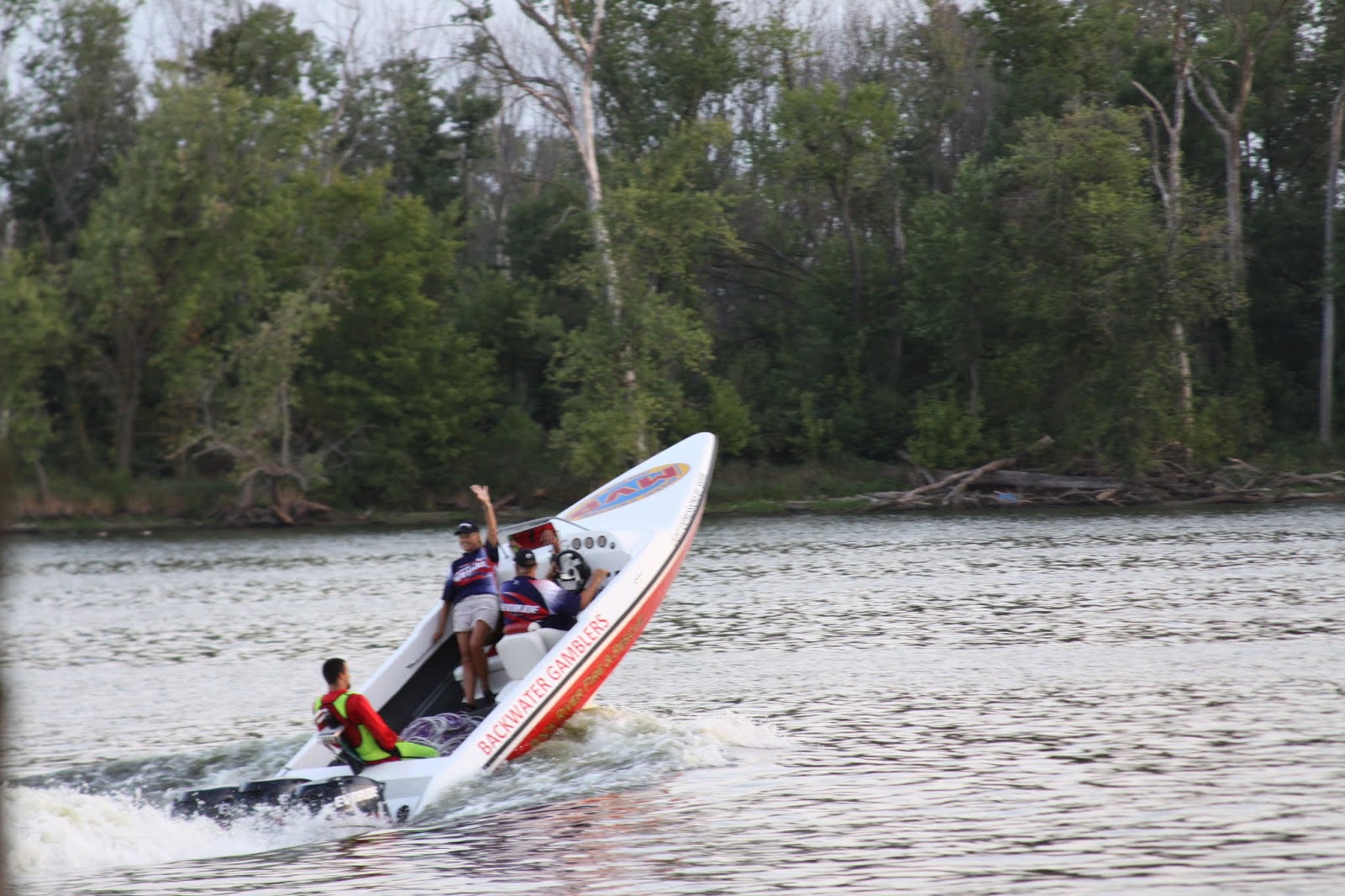
Good news that you can inspire your kids with a ski show and it might cost you nothing.  We went to the Backwater Gamblers show in Rock Island, IL (Quad Cities) on the Mississippi River.  The National Geographic book 100 Places That Can Change Your Child's Life lists Mississippi River as a must see place and claims waterskiing was invented on the Mississippi River in 1922.  We clapped loudly for the ramp tricks, boat tricks, and impressive human pyramids.  Plus we gave donations and bought concessions.  Here's four other free shows you should consider attending:
1.  Aquanut Water Shows; Lance Park in Twin Lakes, WI (close to IL border), Wed. & Sat. 6PM Memorial to Labor Day
Sponsored by Twin Lakes Marine and Gage Marine; show began in 1973 and now the 2018 National Show Ski Ballet Line Champions, contact them for Learn to Ski opportunities in July and August
2.  Chetek Hydroflites Water Ski Show Team; Chetek, WI (Northwest Wisconsin); Thur. & Sun summer shows
3.  Min-Aqua Bat Water Ski Shows; Minocqua, WI, Sun/Wed./Fri. night in summer
One of the oldest show teams in the U.S., club began in 1950
4.  Waterboard Warriors Water Ski Show; Wrightstown, WI (near Green Bay/Fox Valley); Tue & Thur. Memorial to Labor Day

If your child becomes so enthusiastic that they want to learn to ski, consider a ski school: 1) Bass Cove Ski School (Central Lake MI), 2) Barefoot Brothers Water Ski School (Alva, FL), 3) Collier County Water Ski Center (Naples, FL).


6.17.2017

Architecture Lesson #2: Chicago Water Taxi and 3 Boat Tours

A trip to a big city gives you an opportunity to showcase architecture.  You can talk about building types and materials and structural concepts.  Before your outing, draw together different structures such as a suspension bridge, arch, column, post and beam, and dome.  Then on your trip, see who finds the structure first.  You can really make the adventure fun by taking a boat ride and viewing the buildings from the river.

Thanks to our cousins for taking us on the Chicago water taxi.  Tickets cost only $10 for an all day pass and you can buy them onsite at 400 North Michigan and Trump Plaza.  If you want to outsource the architecture lessons to an expert, Chicago has several architecture tours:

1.  Chicago's First Lady Cruises - 90 min, $40 daytime, $43 night ride - Riverside Garden site, learn design of 50 buildings; now ranked by Trip Advisor on the list "10 Great US Tours"
http://www.cruisechicago.com/

2.  Wendella Chicago River Architecture - 75 min tour, $30 adult, $15 children under age 11 - dock near Trump Tower, learn about the architects;
https://www.wendellaboats.com/


3.  Shoreline Architecture Tours - 75 min. tour, adult $35 day, child $21 day, $29 adult night tour, $13 child night - see the Wrigley Building, Trump Tower, Marina City and more.  Depart at Navy Pier's Polk Bros Park;
http://shorelinesightseeing.com/


If you prefer to combine sports and architecture, use your muscle and kayak the river with Kayak Chicago: $69/person 
http://www.kayakchicago.com/tours/architectural-tour/


After the trip, talk about the types of building people live in today.  Perhaps you live in a house, but you saw a lot of apartments in the big city.  Ask your kids about other structures from the past (igloo, teepee, log cabin, pyramid).
"The Bean", Photo by Krenda

 We ended the trip walking to Millennium Park and admiring the Cloud Gate sculpture.  The reflective steel sculpture commonly called "The Bean" was the first public artwork in the US by the famous artist Anish Kapoor.


11.05.2016

Social Sciences & Economics: 5 Free Places to Learn About Money

 Economics, a branch of social science, studies human behavior and scare means.  This article dedicated to my friend working in the Congressional Budget Office in DC.

Kids can learn about goods and resources every time we go shopping and discuss income and expenses.  There's so much more to discuss.  Economist study business climate, the labor market, drivers in fluctuations in oil prices, inflation, and foreign exchange.  President Wilson signed the Federal Reserve Act in 1913.  The US needed a system to stabilize markets, promote financial stability, and setting monetary policy.  Consumers needed confidence and protection and federal banks could ensure banks remained compliant with consumer protection laws.  Bank mergers and acquisitions could be reviewed at the federal level.  The economist and government helped identify solutions to the stock market crash of 1929 and 1987 and financial crisis of 2007-2008.

History, economics, politics, and business can come together in stories.  In 1933, President Franklin Roosevelt needed to rebuild confidence in banking and Congress passed the Emergency Banking Act.  It allowed twelve Federal Reserve Banks to issue additional currency.  Later, the 1933 Banking Act formed the Federal Deposit Insurance Corporation (FDIC).

If you want to bring the concepts alive, consider visiting a money museum.  Please note you'll need to pass security and show government-issue photo id for such government run money museums.  We took the kids to the Federal Reserve Bank of Kansas City The Money Museum (1 Memorial Drive, open 9:30-4PM).  When you enter, you'll see the Harry S. Truman Coin Collection containing over 500 historic coins.  The exhibit includes a $40 million wall with $40 million stacked up.  See a gold bar worth nearly $500K (depends on the timing).  Kids also learn about counterfeit at an exhibit explaining security features designed in currency.  At the end, the employees gave each kid a small bag of shredded cash.  That may have created the most excitement.

Here's five more free entrance places to learn about the economy and banking:

1. Federal Reserve Bank of New York, New York, NY (44 Maiden Lane), M-F 1 & 2PM one hour tours, limited space for public tours and registration opens 30 days prior to requested date, no strollers, no late entrance, security screening first 

2. Atlanta Money Museum, Atlanta, GA (1000 Peachtree Street NE), M-F 9AM-4PM self-guided tours, M-F guided tours at 9:30 AM, 11AM, and 1PM, vie of the banks' automated vault and cash processing area, see robotic transportation, see where dollars are counted, sorted, and shredded daily

3.  Chicago Fed's Money Museum, Chicago, IL (Federal Reserve Bank on 230 South LaSalle St), M-F 8:30-5PM, 45 minute self guided tour, 30 minute guided tour M-F 1PM

4.  Detroit Branch Visitors Center, Detroit, MI (1600 East Warren Avenue), M-Thur. 9AM-4PM, one hour tours

5.  The Denver Money Museum, Denver, CO, (1020 16th St), free, kids can use crayons to design currency, learn the history of the Federal Reserve