Showing posts with label garden. Show all posts

4.18.2018

Global Thinking in the USA #3: Chicago Botanic Garden's Japanese Garden


Chicago Botanic Garden, Photo by Krenda
Chicago Botanic Garden in Glencoe, Illinois (Chicago suburb) is a great place for kids to learn about horticulture.  Look on their website for special events.  I've been to the garden multiple times, but I most enjoyed a Girl Scout event that included dividing houseplants and planting the new plant to help earn a badge.  At the end of the event, we had a private tour of the garden including the Elizabeth Hubert Malott Japanese Garden and greenhouses.  The Chicago Botanic Garden is huge with over 27 gardens within 385 acres.  It's no wonder over 1 million people visit annually.  With approximately 50,000 members, it's the largest membership of any U.S. public garden.  Considering the size and diversity, I'll focus on how kids can learn about horticulture and the Japanese culture in the same place.

To get the lay of the land, the Japanese garden has 17 acres and includes three islands:  1) Seifuto (Island of Clear, Pure Breezes), 2) Keiunto (Island of the Auspicious Cloud), and 3) Horaijima (Island of Everlasting Happiness).  The first two island has public accessibility.  You most likely won't have a guide, so I suggest downloading the garden app, so you and your kids can learn the meanings of the sites.  I've taken a short snapshot of the descriptions provided on the website for you:
Stop 1:  The Ken - viewing point where all three islands can be seen at one spot
Stop 2:  The "Waterfall" - plants create nature scene (boxwoods = stones, cotoneaster flowing downhill = flowing water)
Stop 3:  Kasugastone Lantern - name from Kasuga Shrine where there are nearly 1,000 lanterns
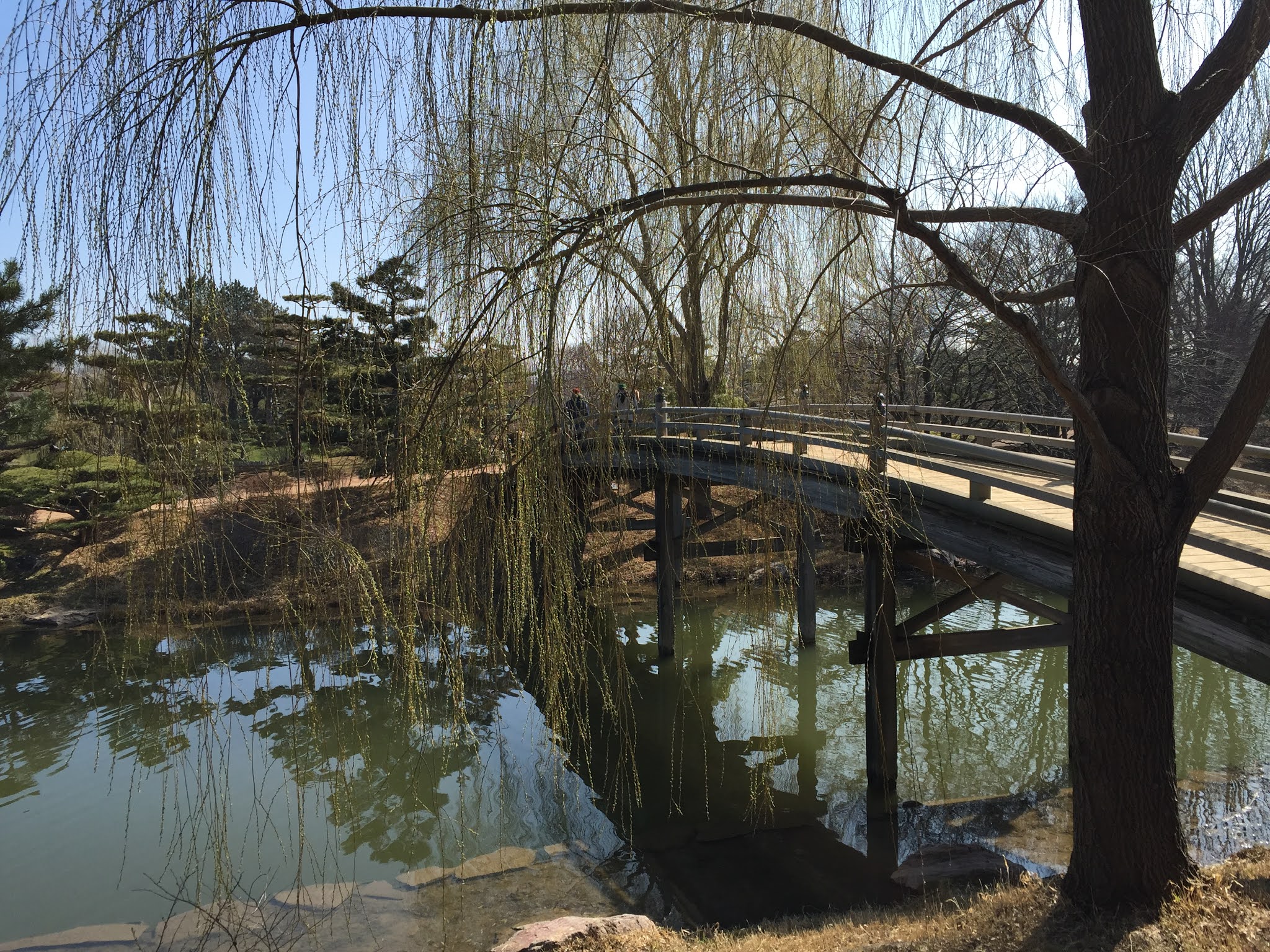
Stop 4: Japanese Garden Bridge - link between this world + paradise with an arch representing the difficulty of the path
Stop 5:  Keiunto - most formal of the gardens


Stop 6:  Dry Landscape Garden - smooth gravel represents calm matter, raked rippled patterns represent waves breaking on a shore; peek into the garden from the house


Stop 7:  Arbor - house adapted from a building at Kodai-jiya Koyota temple, built in Japan and assembled in Chicago

Stop 8:  Crouching Basin - tradition to wash hands and rinse mouth before entering teahouse

Stop 9:  Zig Zag Bridge - legend tells story that people can avoid evil spirits by crossing a zigzag bridge because evil spirits believed to move only in a straight line

Stop 10:  Seifuto - stone lantern and grouping of boulders; rocks are thought to be the bones of the earth

Stop 11:  Boat Landing Stones - 2 large granite slabs for an ornamental boat landing

Stop 12:  Dry Garden and Arbor House - smaller dry garden than on Keiunto; notice the water basin and lantern
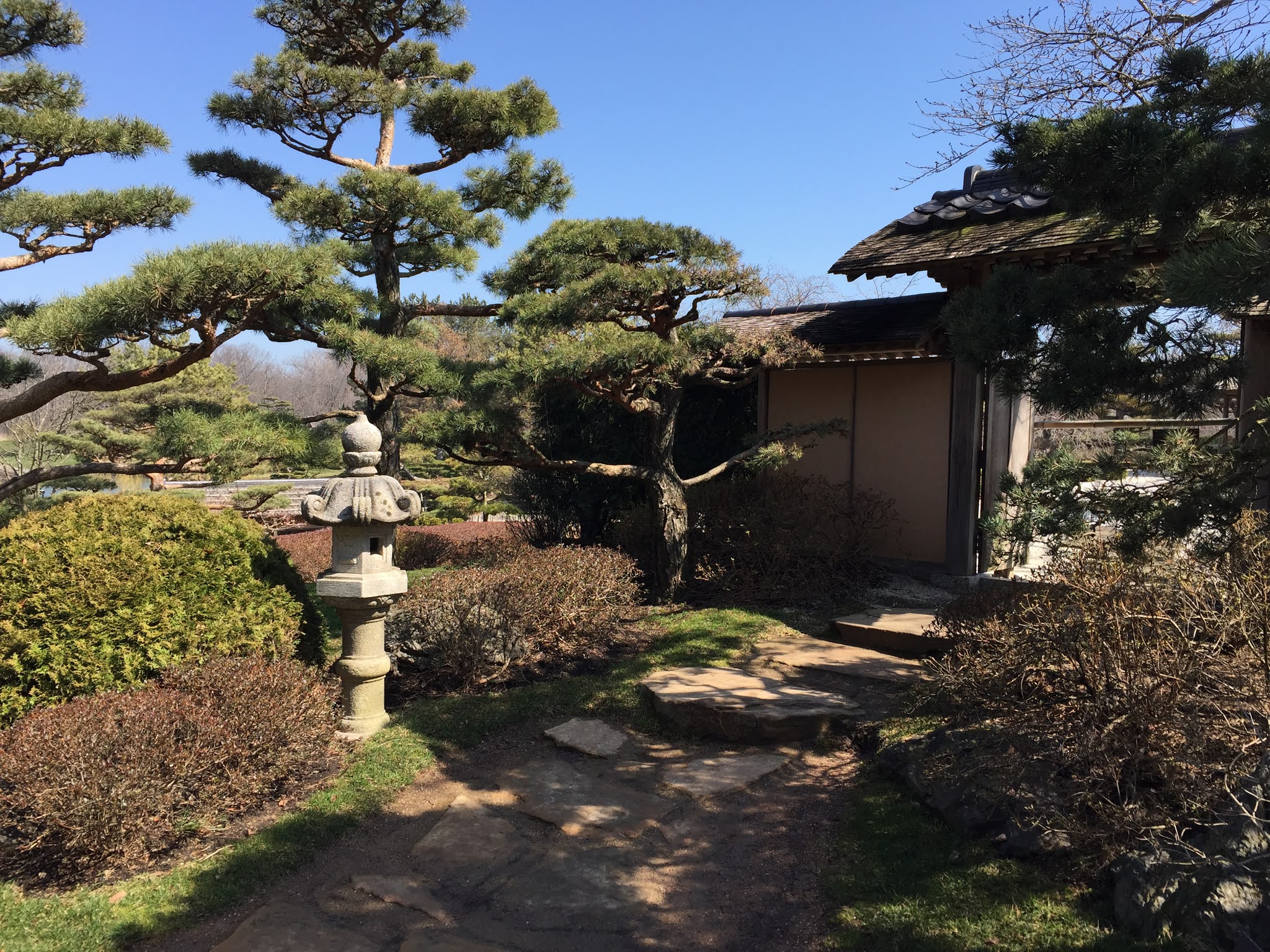
Stop 13:  Willow - uneven pathway of stones to make you step more deliberate; notice the pruned willow

Stop 14:  Pine Tres - symbols of long life in Japanese culture

Stop 15:  Shoin House:  Recreated garden retreat of an Edo-period feudal lord built in Japan

Stop 16:  Water basin at the Shoin House

Stop 17:  Snow-Viewing Lantern - yukimi lantern built with sturdy legs and broad umbrella, enabling it to bear the snow

Stop 18:  Puryear Point - bridge views and sculptures

The Forest Preserve District of Cook County owns the garden and the Chicago Horticultural Society manages the garden.  There's an agreement for free admission (beyond the $25-$30 parking fee per day) until 2022, so visit now.

11.04.2017

Art Lesson #10: The Getty Museum - Los Angeles, California

The Getty, Photo by Krenda
When you combine stunning art, architecture, and gardens, the beauty amazes the senses.  I recommend you visit The Getty Center in Los Angeles, California.  Patricia Schultz, author of travel book 1,000 Places to See Before You Die, also recommends the site.  She describes the museum as a "futuristic shrine to the art of the past" and describes the buildings "the hilltop citadel is a work of art itself, done in gleaming off-white travertine marble and glass.


You could spend the day just exploring outdoors because of the multiple gardens and beautiful views of the Santa Gabriel mountains, Pacific Ocean, and Los Angeles city.  Everything has a grand scale.  The Central Garden uses 134,000 square-feet to house over 500 varieties of plants.  My photograph shows the Cactus Garden which has quite the view.  Also walk through two sculpture gardens - Lower Terrace Sculpture Garden and The Fran and Ray Stark Sculpture Terrace.

 The buildings within the $1.3 billion Center have such striking, modern lines and curves.  The building itself is art.  From a distance you can tell it has grand scale.  When you take the tram up the hill and immerse yourself in the campus, it is even more impressive.  Architect Richard Meier designed the campus to encompass nature and culture, using 16,000 tons of travertine stone from Tivoli, Italy.  He designed the rooms to let natural light show off the paintings.  You can see it from my photo.  Sunshine outdoors and bright, light rooms make you feel sunny.

Exploring inside could take many visits including four pavilions:

1) North Pavilion - paintings up to 1600, Medieval and Renaissance, sculptures

2) East Pavilion - 17th century Baroque art, including Dutch, French, Flemish, and Spanish

3) South Pavilion - decorative arts and furnished rooms

4) West Pavilion - sculpture and Italian decorative arts and Center for photographs

If you feel pressed for time, don't miss the famous Vincent Van Gogh painting "Irises".  I stayed until the last minute, also providing time to watch the sunset over the city and the campus to light up in the night sky.

Free admission, but you need to consider parking and whether you need to purchase food.  If I visited again, I'd take advantage of their parking special - one fee ($20) for both Getty Center and Getty Villa when visited same day (except Mon. or Tue.) and confirmed at information desk.  I'd begin at the Villa to admire ancient world art, drive to a restaurant for lunch, and drive the 20-45 minutes to Getty Center.   Besides saving on the parking, the timing could save me from expensive museum meals.  Other Getty Center parking deals include $15 after 3PM or $10 after 6PM on Saturday.

10.04.2017

Art Lesson #9: Quad Cities Botanical Center Flamingo Follies

When you combine art and nature, you have an extra special experience.  If you visit Rock Island, Illinois, one of the Quad Cities, you should visit The Quad Cities Botanical Garden located near the Mississippi River with a striking glass building.  If you time it right, you could visit their "Flamingo Follies" event which displays plastic flamingo art.

The art program supports the non-profit.  With a $10 fee, you pick up a plastic flamingo, decorate it, and deliver it to the garden for display.  Participants have an opportunity to win in one of three categories (adult, youth, or professional).  The botanical center utilizes the art to entertain guests and provide a second fund-raiser.  Adult entries raffled off at Art in the Garden help support the non-profit.

We timed one of our visits to the Quad Cities Botanical Garden right.  We were able to see the decorated flamingos amongst the tropical Sun Garden.  This garden has palm trees, fish, coconut and chocolate trees, and orchids.  The 14-foot waterfall adds to the lush environment. 

When you have a nice day, check out the outdoor garden too.  It includes a butterfly garden and places to relax.

Our interest in this botanical garden began before construction began.  At a bridal expo, I learned about the plans for the botanical garden with a banquet facility.  Considering our love for nature, supporting a non-profit with our wedding reception business felt just right.  Without a brick laid, we took a chance and signed a contract.  We had a wonderful experience with guests able to visit the garden prior to the reception, catered dinner, and a dance floor.  Later we donated to buy an engraved brick that was paved as part of the walkway.  You can help the garden by visiting ($7 adult, $4 youth), buying a membership ($70 annual family), buying a 4x6 brick ($150).  If you have a group of 10 or more, you have more options.  You can arrange a tour (self guided $5 each, tropical paradise $7, chocolate tour $12, botanical bliss with essential oil making $15).  The garden location was so right for our reception.  Taking a chance led to a beautiful experience.  Now you can go visit and decide for yourself.


11.01.2016

Art Lesson #8: Chihuly Garden and Glass in Seattle Washington


For a short history of glass art, your kids will find it interesting that glassmakers were once forbidden to leave Venice or teach their skills to foreigners.  It's interesting how change creates new connections.  The secrecy of the craft was maintained until 1962.  Harvey Littleton started teaching glass blowing at the University of Wisconsin in 1962 and Dale Chihuly was enrolled in the first glass program.  Chihuly was the first American invited to work at Veneni glass factory in Venice.  In 1998, Chihuly created Chihuly Over Venice exhibit and installed them over canals and piazzas of Venice.  His art connected him back to Venice.  

The year 1962 wasn't only the first glass program in the United States, it was also the year Seattle hosted the World's Fair.  Ever since then, the Space Needles has remained an icon.


  Born in Washington, Chihuly was invited by the Wright family who owns the Space Needle to present his work.  In 2011, the Chihuly Garden and Glass construction began.  Chihuly repurposed an existing building on 1.5 acres near the Space Needle for a long-term exhibit.  His art connected back to his community.

You and your family will really enjoy the visually spectacular space and glass of the Chihuly Garden and Glass exhibit in the Seattle Center.  While it's not close to free admission ($32 per adult, $49 package with nearby Space Needle), it's such a unique experience to see Chihuly art both inside and outside.  I've seen his art in botanical garden installation, but not the close up exhibit which includes his Macchia series.  Macchias was one of his collections in the 1980s, along with Seafoams, Venetians, and Persians.  Macchia comes from the Latin word macula meaning a stain or spot. Chihuly began Macchia with an inspiration to use all 300 colors in his hotshop, fusing colored glass chips on the the exterior layer to create a spotted effect.  If you want to buy a Macchia art piece, it will cost you 6 to 9 thousand dollars.  Now the $32 entrance doesn't sound too bad.

After buying your ticket, you will enter the indoor exhibits which includes eight galleries.  In a dark room, the Chihuly glass in vibrant color lights up the room.  Other people walked into the room and we all stared in silence.  Ikebana and Float Boats pictured here is one of the two wooden boats used as a base for the exhibit.  Chihuly presented his first chandelier piece at t 1992 exhibition at the Seattle Art Museum.  In Seattle, you can see impressive chandeliers hanging from the ceiling at this location.  A green one, a blue and white one, a red one, and the green one photographed here.

You'll proceed to the glass house.  There is something about art combined with space and light that has a wow factor and luxurious feel.  The 40-foot tall glass and steel structure covers 4,500 feet.  Light fills the room and you'll admire the 100-foot long orange and yellow glass sculpture suspended above you.  

You'll continue to see different art pieces in the gardens outside such as icicle towers and reeds on logs.  I was fortunate to time my visit right to a live glass demonstration.  While in Seattle, I also recommend you visit Pike Place Market and it's free entry!  Read my blog story about my experience.


10.03.2015

Art Lesson #7: From UK to US, Art Light-Based Installations Bring Joy

The UK artist Bruce Munro has created many solo exhibitions in the United States.  Visit his website to see his latest exhibitions.  When interviewed, Munro discusses how life is about telling stories.  Bruce tells his stories in immersive large-scale light-based installations as a way to express ideas and feelings and communicate connection.  He wishes his art to bring a feeling of joy and measures success as making others smile.  I certainly smiled and felt joy seeing his art at the "Forest of Light" exhibition at the Atlanta Garden. 

From my parking spot, I walked through Piedmont Park and enjoyed the sights and sounds of music and laughter at the local festival.  I wanted to arrive early to the light event, seeing it both in daylight and darkness.  Considering the exhibition included six pieces, I had a lot of ground to cover. 

I was mesmerized by his piece utilizing lights in clear plastic soda bottles.  Arranged as circular towers, the light took height.  The lights would change from one primary color to another.  To add to the magic, you could see the Atlanta skyline from a distance.

The garden canopy, my favorite piece, consisted of 30,000 flower-like stems that lit up on the ground.  The light moved and made the garden feel like a fairy-tale.  The frosted glass orbs and fiber optic lights pulsated and made me want to stay in the garden.  I'd walk back and forth, across the bridges to keep myself immersed in the lighted space. 

Bruce Monro began as a painter.  He recognized painting as being about light and light as a way to discovery.  Many public gardens will bring exhibits to their grounds to display art.  I encourage you to discover these special exhibitions.  Check out your local garden events pages and immerse yourself in a joyful place.

1.03.2015

Science Lesson #2: 2 Free Venus Fly-Trap Viewings + 4 Other Botanical Gardens


Meat-eating plants!  Oh my!  Plants eating ants, flies, spiders, and other insects sound like a bizarre science-fiction film, but you and your kids can see the process in action.  Visit a fly-trap farm or botanical center with venus fly traps, pitcher plants, bladderworts, and sundews.  
 
How does a plant capture an insect?  The venus fly-trap emits a fruity scent that attracts insects.  Tiny bristles within the leaf trigger the plant to close when an insect brushes against it.  Once the insect gets captured inside, the plant has a "green stomach", producing digestive enzymes and transporters to take up nutrients.  It can take several days to digest the insect.  
The venus fly-trap is native to Cape Fear, North Carolina.  The loss of habitat has led to 95% of the original plants to disappear.  There's now less than 30,000 plants in the wild.  However, farmers grow the plants and sell them at their nursery or online.

We visited the largest botanical collection of carnivorous plants on display to the public in the US.  Located 45 minute north of San Francisco in Sebastopol, CA, California Carnivores is open Thur. to Mon. 10AM-4PM to the public.  The owner has grown carnivorous plants for nearly 50 years, wrote the book The Savage Garden:  Cultivating Carnivorous Plants, and featured on Martha Stewart Living.  Unfortunately the plane transportation meant we couldn't buy plants onsite.  However, it inspired us to visit our local home improvement stores and we easily found a kit to buy.

 Another way to see the plants for free - visit The United States Botanic Garden Savage Gardens in Washington D.C. from 10AM to 5PM.  Here's four other botanical gardens featuring meat-eating plants:

1.  MOSI Museum of Science & Industry Coleman-Lienhart Savage Garden, Tampa, FL, adults $27, child $21

2.  Frederick Meijer Garden Kenneth E. Nelson Carnivorous Plant House, Grand Rapids, MI, adults $15, children under age 13 for $7, over 150 acres

3.  Dallas Arboretum and Botanical Garden The Carnivorous Plant Bogs located in Rory Meyers Children's Adventure Garden, adult $15, child under age 12 for $10

4.  Franklin Park Conservatory and Botanical Garden Savage Gardens, Columbus, OH; $14 adults, $7 child under age 17, plants and sculptures


6.07.2008

History Lesson #1: Casa Loma Castle in Canada


     Why not dream big? And dream big early.  Tour the Casa Loma castle or "House on the Hill" in Toronto, Canada for a business and history lesson of a dreamer.
     Sir Henry Pellatt left his studies at age 17 to pursue business. By age 23, he acted as a full partner in his father's stock brokerage firm Pellatt and Pellatt.  Henry founded the Toronto Electric Light Company in 1883. He acted as chairman of 21 countries by 1901.  Henry had his Gothic Revival style castle built with 98 rooms in 180,000 square feet including Sir Henry's Study, Sir Henry's Suite, The Conservatory, The Billiard Room, Lady Mary's Suite, Breakfast Nook, The Great Hall, The Library, The Oak Room, and a theatre.  The castle has served as a private home, nightclub, hotel, and now a public historical landmark you may tour.
Fun Facts:  $3.5 million and 3 years to build; 800 foot underground tunnel; 5 acre estate garden; 8 language choices available in the self guided audio tour
Tips:  Ticket price is high at approximately $30.  Consider the Toronto City Pass.  It costs more ($73 adult, $49 child), but the pass could save you overall if you visit multiple sites in Toronto. The pass includes entrance to multiple tourist attractions: 1) Casa Loma, 2) Royal Ontario Museum, 3) CN Tower, 4) Ontario Science Centre or Toronto Zoo, and 5) Ripley's Aquarium of Canada.
     Casa Loma gives Kindergarten to 8th Grade groups lower pricing ($10 each) and a variety of educational programs:  General History Tour, Armour and Weapons, How Does Your Garden Grow, An Edwardian Childhood, Enchanted Tales of Lore, Legend, & Magic, Medieval Studies Tour, Hollywood Tour (movies featured Casa Loma including X-Men, Strange Brew, Chicago, and Scott Pilgrim vs. The World), and Lady Pellatt's Lost Jewels Tour. 
 
     At only one month old, my son didn't soak in the historical stories.  He might have enjoyed the sunshine in the garden.  The gardens opened in 1990 and are included in the admission, thanks to the $1.5 million dollar renovation by The Garden Club of Toronto, The Kiwanis Club of Casa Loma, corporations, foundations, individuals, and the government.  Keep on growing, learning, and dreaming!